In the face of frequent power outages, Ukrainians are increasingly seeking reliable and economical solutions for autonomous lighting. Rechargeable LED lamps have become a true lifesaver, as they combine the energy efficiency of LEDs with the ability to operate without being connected to the grid. Following a recommendation from the ComfortShop editorial team, we conducted our own test of several popular models to determine which ones are truly worth attention and capable of providing comfortable light during a blackout.
Article Contents
- Why LED Lamps with Batteries Are the Ideal Solution for Blackouts
- Our Test Criteria: What We Evaluated
- Test Results: Leaders in Price-Quality Ratio
- Energy Savings During Outages: How Much You Will Save
- Practical Tips for Operating Autonomous Lamps
- Comparison with Other Autonomous Light Sources
- Conclusion:
Why LED Lamps with Batteries Are the Ideal Solution for Blackouts
Unlike conventional incandescent lamps or even standard LED lamps, rechargeable models have a built-in power supply that allows them to shine independently of the voltage in the grid. This makes them indispensable during emergency outages, as they do not require separate power banks or complex connection schemes.
The main advantage of such lamps is their instant readiness for operation. You don't need to search for candles or a flashlight in the dark: the lamp screws into a standard socket and charges when electricity is available. As soon as the power supply goes out, it turns on automatically or is activated by pressing a button. Furthermore, modern LED lamps consume minimal energy, allowing them to operate for 4 to 8 hours on a single charge.
Our Test Criteria: What We Evaluated
For an objective review of rechargeable LED lamps, we selected five models from different price categories and power levels. The testing was conducted under conditions as close to real-life as possible: we simulated a sudden power outage and measured several key parameters.
- Battery life: how many hours the lamp can shine at maximum brightness after a full charge.
- Brightness and color temperature: measurement in lumens and assessment of the light's comfort for the eyes.
- Full charge time: how quickly the lamp restores battery capacity from the grid.
- Functionality: availability of additional modes (dimmer, emergency mode, ability to work as a night light).
ComfortShop experts also advise paying attention to the battery type: lithium-ion batteries last longer and have lower self-discharge compared to nickel-metal hydride ones. In our test, all models used Li-Ion batteries.
Test Results: Leaders in Price-Quality Ratio
First place in terms of overall characteristics went to a 10 W model with a luminous flux of 800 lumens. It operated for 6 hours and 20 minutes at full brightness, which is an excellent indicator for household use. Its color temperature of 4000K (neutral white light) proved to be the most comfortable for reading and working.
Second place was awarded to a compact 7 W lamp with dimming capability. It allows you to adjust brightness from 10% to 100%, which is especially convenient at night. The battery life in minimum mode reached 12 hours, and in maximum mode — 4 hours and 45 minutes. This is a great option for a children's room or bedroom.
Third place — a model with an emergency lighting function. It automatically turns on when the mains voltage disappears, even if the light switch is off. This is an ideal solution for hallways, basements, or stairwells where safety and spatial orientation are critically important.
Energy Savings During Outages: How Much You Will Save
Using rechargeable LED lamps is not only convenient but also provides significant savings. LEDs consume up to 90% less electricity than traditional incandescent lamps. Even considering charging cycles, the cost of one hour of light from a rechargeable LED lamp is tens of times lower than from a candle or kerosene lamp.
During prolonged outages, this allows not only saving on charging power banks for other devices but also reducing the load on the home electrical network after power is restored. Additionally, the service life of LED elements reaches 30,000–50,000 hours, making such lamps a profitable long-term investment.
How to choose the ideal lamp for your home:
Pay attention to the base: the most common options are E27 and E14. For large rooms, choose models with a luminous flux of 600 lumens or more; for night lighting, 200-300 lumens are sufficient. Also, check for protection against overheating and short circuits — this is important for safety.
Practical Tips for Operating Autonomous Lamps
To ensure your rechargeable LED lamp lasts as long as possible, follow a few simple rules. Do not leave it discharged for a long time — periodically recharge the device even if there are no outages. The optimal charge level for storage is 40-60%.
Also, avoid using the lamps in conditions of high humidity without appropriate protection (IP44 or higher). If you plan to use the lamp outdoors or in unheated rooms, choose models with a wide operating temperature range.
Regularly check the contacts and the power button — they can become clogged with dust. Simply wiping them with a dry cloth will extend the mechanism's lifespan. Remember, a quality lamp is an investment in your comfort and safety during blackouts.

Comparison with Other Autonomous Light Sources
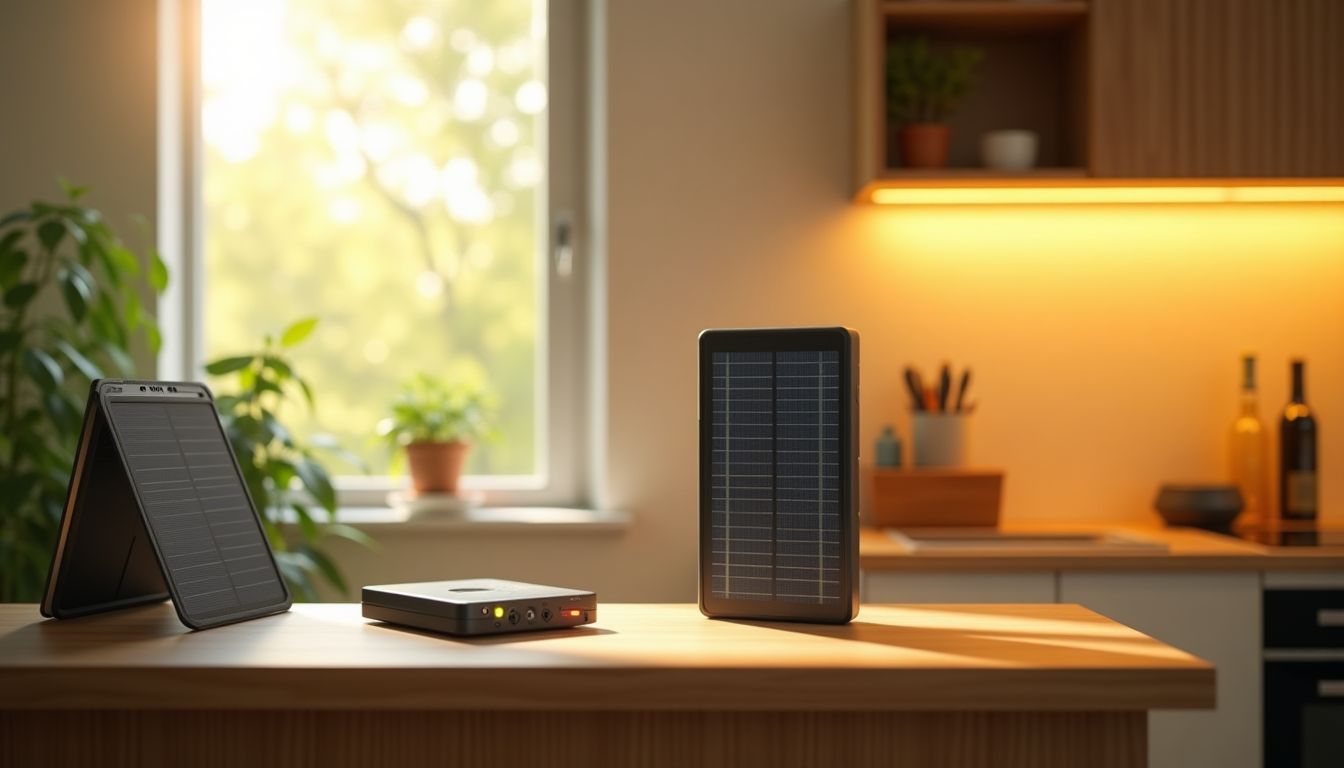
There are many alternatives on the market, from ordinary flashlights to solar panels with batteries. However, rechargeable LED lamps win due to their versatility. They don't take up space on the table, don't require additional wires, and can be used as regular lighting at any time.
Compared to candles, they are completely fire-safe and do not emit harmful substances. Unlike gas lanterns, they do not require ventilation. And compared to power banks with USB LEDs, battery-powered lamps are simpler to use: you simply screw them into the socket and forget about the need to carry additional devices with you.
As ComfortShop reviewers note, this lighting format is the most practical for apartments and houses where it is important to maintain the usual interior and not sacrifice comfort during outages.
Conclusion:
Our test confirmed that rechargeable LED lamps are the optimal choice for autonomous lighting in the context of Ukrainian realities. They combine energy efficiency, long operating time, and ease of use. By choosing a model with a high-quality lithium-ion battery and a power of 7 W or more, you get a reliable light source that won't let you down at the most critical moment. We recommend purchasing at least 2-3 such lamps for key rooms to always have light, regardless of outage schedules.
Frequently Asked Questions
Can rechargeable LED lamps be used in regular light fixtures?
Yes, most of these lamps have a standard E27 or E14 base, so they fit regular chandeliers and table lamps.
How long does a rechargeable LED lamp work after a full charge?
Operating time depends on the battery capacity and brightness: on average, from 3 to 8 hours in maximum mode.
How quickly do such lamps charge, and can they be left on while charging?
A full charging cycle takes 4 to 6 hours, and many models allow simultaneous charging and lighting, which is convenient during an unstable grid.
Do rechargeable LED lamps save electricity compared to regular incandescent lamps?
Yes, they consume up to 90% less energy, and the built-in battery allows you to use stored light without additional cost during a blackout.