Choosing a flashlight for a hiking backpack often turns into a real challenge. Manufacturers promise an incredible 1000 lumens, but in practice, the light turns out to be dim, and the battery dies in two hours. To avoid disappointment on the trail, it's worth understanding which characteristics truly matter and which are just a marketing gimmick. Following the recommendation of the ComfortShop editorial team, we have prepared an honest review of a 1000 lm flashlight to help you make an informed choice for night crossings and campsites.
? Table of Contents
Why 1000 Lumens Isn't Always the Truth: Real Brightness on a Hike
The first thing that catches your eye when studying the specifications is the stated power. Many manufacturers list a maximum of 1000 lumens, but this is only achieved for a few seconds when starting with a cold battery. In real-world conditions, after 10-15 minutes of operation, the brightness drops to 400-500 lumens due to overheating and automatic power reduction.
For a hiking flashlight, it's not the peak brightness that matters, but the stable brightness. If you plan on prolonged nighttime use, you should look for models with active cooling or a massive heatsink. Ideally, a 1000 lumen flashlight review should include a test of the light output stability over an hour. Even a stable 600-700 lumens will be more useful than 1000 lumens that fade away in 5 minutes.
It's also important to understand that the human eye perceives brightness non-linearly. The difference between 500 and 1000 lumens is not visually twice as noticeable — it represents only about a 30% increase in perceived brightness. Therefore, you shouldn't chase absolute numbers; it's better to focus on the quality of light and its distribution.
Design and Materials: What Can Survive a Fall from a Backpack
A hiking flashlight for a backpack needs to be not only powerful but also durable. An aluminum body with an anodized coating is the standard for quality models. It is lighter than steel but significantly stronger than plastic. It's important that the flashlight has protection according to the IP68 standard — this means it can withstand immersion in water up to 1 meter deep for 30 minutes.
Special attention should be paid to impact resistance. A powerful flashlight for hiking often falls from waist or backpack height. Manufacturers usually specify resistance to drops from 1-1.5 meters onto concrete. However, in practice, the lens glass most often suffers — it can crack upon impact with a stone. Quality models use tempered glass at least 2 mm thick or polycarbonate.
Ease of attachment also plays a role. The flashlight should have a reliable carabiner or magnetic mount so it can be quickly secured to a backpack or belt. Some models have a swivel head, allowing you to change the direction of the light without having to reposition the flashlight itself.
Power: Rechargeable Battery or Disposable Batteries in the Field
The choice of power source is a key point for any hiking gear. A 1000 lumen flashlight review often shows that lithium-ion batteries provide the best weight-to-capacity ratio. However, on a long hike without access to an outlet, they become a problem. The alternative is flashlights that run on standard AA or AAA batteries, which can be bought in any village.
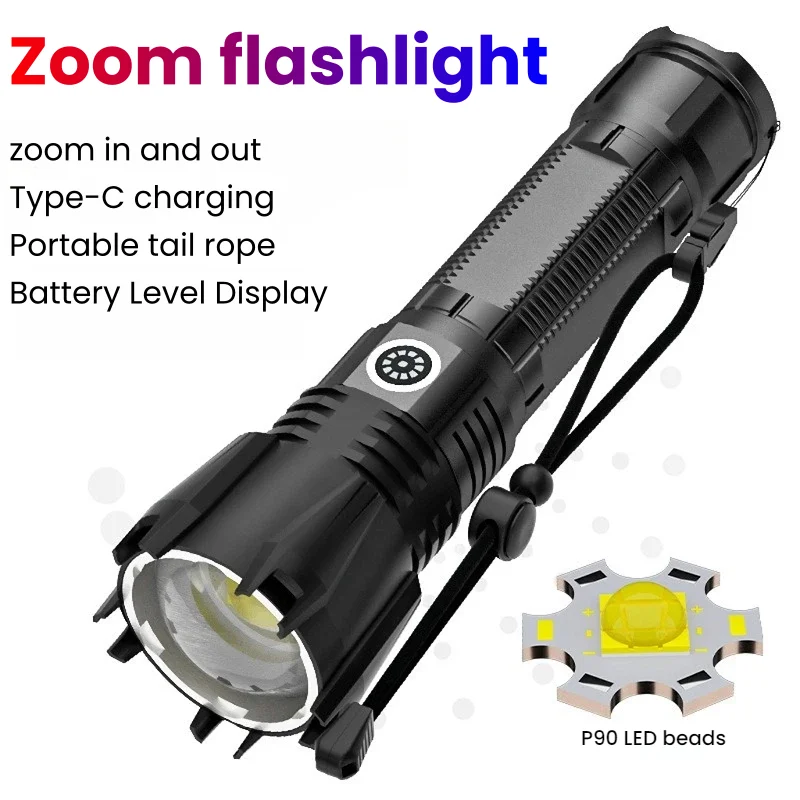
A compromise option is hybrid models that run on a built-in rechargeable battery but also have a compartment for backup disposable batteries. ComfortShop experts advise choosing flashlights with USB-C charging support — this allows you to use a power bank for recharging at night. It's important to check if the flashlight can be charged while in use; otherwise, you'll have to wait several hours.
Runtime at maximum brightness rarely exceeds 2-3 hours for 1000 lumens. Therefore, you should look at the runtime in economy mode (100-200 lumens) — it can be 10-15 hours, which is enough for evening campsites. Some models have a charge indicator function, which helps plan usage.
Optimal choice for long hikes: hybrid power.
Light Modes and Beam Distance
A powerful flashlight for hiking should offer at least 3-4 brightness modes. The most useful are maximum (for illuminating distant objects), medium (for walking on a trail), and minimum (for working in a tent). Some models also have a strobe or SOS mode, which can be useful in extreme situations.
Beam distance is a characteristic that is often misleading. Manufacturers state the maximum distance achievable under ideal conditions (total darkness, no fog). In a real forest with obstacles and humidity, this figure drops by two to three times. For most hikes, a distance of 100-150 meters is sufficient, as you simply won't see obstacles further away due to the terrain.
The beam shape is also important. A narrow beam with a high concentration of light (spot) is good for viewing distant objects but inconvenient for walking. A wide beam (flood) illuminates a large area in front of your feet, which is safer on difficult terrain. The ideal flashlight has combined optics that allow you to adjust the focus.
Weight and Ergonomics: Is It Worth Carrying Extra Grams
Every gram in a hiking backpack matters. A 1000 lumen flashlight review shows that the average weight of such models is 150-250 grams without batteries. With the battery and body, this can be 300-400 grams. For comparison, lighter 500 lumen models weigh 100-150 grams, so it's worth asking yourself if you really need the maximum power.
Ergonomics includes not only weight but also the shape of the body. The flashlight should fit comfortably in the hand, not slip when wet, and have a button that can be pressed while wearing gloves. Some models have side lighting or a red LED that doesn't blind the eyes and doesn't attract insects — this is very convenient for evening campsites.
You should also pay attention to the button placement. It shouldn't be pressed accidentally in the backpack, otherwise the flashlight will turn on and drain the battery. Most quality models have an accidental activation lock (e.g., long press or head rotation).
Conclusion:
An honest review of a 1000 lm flashlight shows that there is no perfect universal solution. For short night crossings or bike rides, a powerful model with a lithium-ion battery will suffice. For long, self-sufficient hikes, it's better to choose a hybrid option with the ability to use disposable batteries. The ComfortShop reviewers recommend not chasing maximum lumens, but choosing a flashlight with stable brightness, a durable body, and a convenient mount. This way, you'll get a reliable companion that won't let you down at the most crucial moment.
Frequently Asked Questions
Does a 1000 lm flashlight really shine at 1000 lumens?
In most budget models, the actual brightness is lower — around 600-800 lumens due to overheating and battery limitations. For a hiking backpack, choose flashlights with verified reviews where the manufacturer states real performance figures.
Which battery is better for a powerful flashlight on a hike?
The best choice is 18650 or 21700 lithium-ion batteries; they are lightweight and have high capacity. For a long hike, take spare batteries or a model with USB-C charging.
Is a 1000 lm sports flashlight suitable for night runs?
Yes, but pay attention to weight and mounting — lightweight models under 200g with a headband and adjustable light angle are more comfortable for running. A power of 1000 lm provides sufficient trail illumination.
How long does a 1000 lumen flashlight last on maximum brightness?
Usually 1-2 hours, after which it automatically reduces brightness to protect against overheating. For night hikes, it's better to use the medium mode (300-500 lm), which holds a charge for 4-6 hours.