Electric cars have ceased to be a futuristic luxury and are gradually becoming part of everyday life for Ukrainians. For many drivers, the Nissan Leaf is their first experience with electric vehicles. This model has long earned the status of a people's electric car thanks to its affordable price on the secondary market. But is it worth buying today, when competition is growing? According to the recommendation of the ComfortShop editorial team, it is worth understanding all the nuances to see if this car is right for you.
Article Contents
Success Story and Market Positioning
The Nissan Leaf debuted in 2010 and became one of the first mass-market production electric cars. Over more than ten years, the model has seen two generations, but the first generation (ZE0 and AZE0) has gained the most popularity in Ukraine. The reason is simple — the cost of such cars on the secondary market starts at $8,000-10,000, making them a real alternative to budget gasoline cars.
Today, the Nissan Leaf is perceived as an ideal city car for those who want to try electric power without significant financial risk. It does not claim premium status, but honestly fulfills its main function — transporting the driver and passengers with minimal fuel costs.
Technical Specifications and Real Range
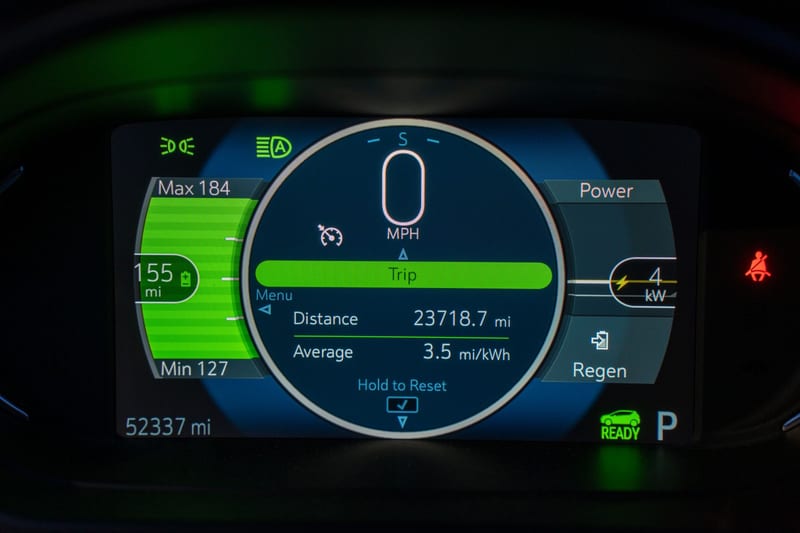
One of the most important aspects for any electric car is the battery. The first generation Nissan Leaf was equipped with batteries of 24 kWh (later 30 kWh). The official range is about 120-170 km, but in real-world conditions, the figures differ.

In summer, in the city cycle, you can expect 90-110 km with careful driving. In winter, due to the cold and use of the heater, the range drops to 60-80 km. This is a critical point for those planning to use the car for daily commutes outside the city. As ComfortShop reviewers note, for a city with mostly short trips, this is quite sufficient, but for long journeys, you will need to carefully plan a route with charging stations.
Dynamics and Handling: What You Need to Know.
The electric motor produces 109 horsepower, providing decent dynamics in the city — the car accelerates to 100 km/h in about 11 seconds. This is enough for confident overtaking in traffic. The Leaf's handling is quite comfortable, although the weight of the batteries is noticeable — the car feels a bit heavy in corners.
The main advantage is the instant torque, which makes starting from a traffic light very pleasant. But you should be prepared for the fact that on the highway at speeds over 100 km/h, the charge drains rapidly.
Operating Costs and Maintenance
Savings on fuel and maintenance are the main arguments in favor of the Nissan Leaf. The cost of a full charge from a home outlet (220V) at night using a reduced tariff is only 30-50 hryvnias. This is many times cheaper than gasoline. Additionally, the electric car lacks the consumable parts of an internal combustion engine — oil, filters, belts, spark plugs.
However, there are specific nuances. The most vulnerable element is the high-voltage battery. Its degradation over time is inevitable. Before purchasing, be sure to check the battery condition using special diagnostic equipment or mobile apps (e.g., Leaf Spy). A capacity loss of over 30% significantly reduces the car's practicality.
What Else to Consider When Buying.
Also, pay attention to the condition of the battery cooling system (in the first versions, it is passive, which accelerates degradation in hot weather). Replacing the battery can cost half the price of the car itself, so this is a key point. ComfortShop experts advise choosing models from 2013 and newer, where some of the "teething problems" were fixed.
Pros and Cons of the Nissan Leaf for Ukrainian Realities
To get a complete picture, it is worth outlining the model's strengths and weaknesses. This will help you understand whether the Leaf will be your ideal first electric car.
- Pros: low price on the secondary market, minimal charging costs, simple design (fewer parts that break), quiet and smooth ride, availability of CHAdeMO fast charging.
- Cons: short real range (especially in winter), lack of an active battery cooling system (in the first generation), battery degradation with age, small trunk (330 liters), outdated interior design.
For many Ukrainians, the combination of price and efficiency outweighs the drawbacks. The Leaf is ideal as a second family car for city trips or as a first electric car for learning the technology without a large investment.
Tips for Choosing on the Secondary Market
If you decide to buy a Nissan Leaf, approach the selection as responsibly as possible. The best option is a car from Japan or Europe with a transparent service history. Avoid cars with obvious signs of repair after an accident — this can affect the safety and operation of the high-voltage systems.
Be sure to check the number of fast charges (QC count) — frequent use of CHAdeMO stations accelerates battery wear. An ideal indicator is no more than 200-300 over the entire service life. Also, pay attention to the year of manufacture: models from 2015-2017 with a 30 kWh battery are considered a more balanced choice.
Conclusion:
The Nissan Leaf is an honest and reliable electric car for the city, allowing you to get all the benefits of electric power for minimal money. It is not perfect, has a limited range, and requires careful selection on the secondary market, but for a first introduction to electric transport in Ukraine, it is undoubtedly one of the best options. If your daily trips do not exceed 60-80 km and your budget is limited, feel free to consider this model as your first step into the world of electric cars.
Frequently Asked Questions
What is the real range of a Nissan Leaf on a single charge in winter?
In winter, the real range of a Nissan Leaf decreases by 30-40% due to the cold and heater use, so for a model with a 40 kWh battery, you should expect 120-150 km instead of the stated 240 km.
Is it worth buying a used Nissan Leaf as a first electric car in Ukraine?
Yes, it is one of the best budget options for getting acquainted with electric transport in Ukraine, but be sure to check the battery condition (SOH) — it should be no lower than 80% for comfortable use.
How fast does a Nissan Leaf charge from a regular home outlet?
From a regular 220V outlet, a full charge of a 40 kWh battery takes about 10-12 hours, which is ideal for overnight charging at home.
Is the Nissan Leaf suitable for daily city and highway trips?
The Nissan Leaf is excellent for the city due to its compactness and efficiency, but on the highway at speeds over 100 km/h, the range quickly drains, making it more of a city electric car.