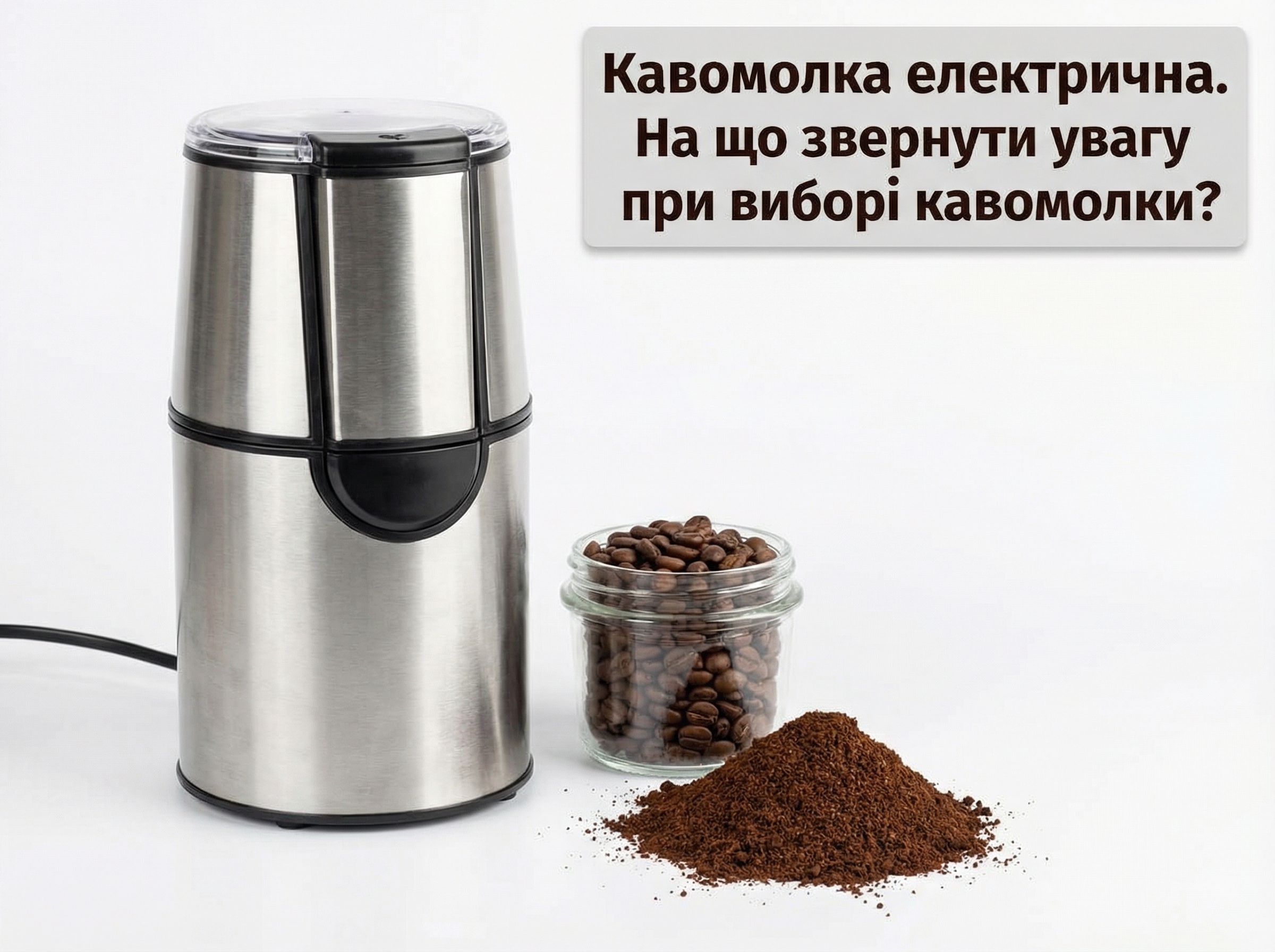
Electric Coffee Grinder: Your Path to the Perfect Cup of Coffee
The true coffee ritual begins not with brewing, but with grinding. Aromatic beans, transformed into fine, medium, or coarse grounds, unlock the full spectrum of flavor and aroma. An electric coffee grinder is a key tool for anyone who values quality and consistency. But how do you find the right one among the variety of models? Let's break down what to look for when choosing.
Type of Burrs: Blade or Burr — A Fundamental Choice
The first and most important decision is the type of mechanism. It determines not only the grind quality but also the variety of coffee brewing methods available to you.
Blade coffee grinders work on the blender principle: sharp blades chop the beans at high speed. They are generally cheaper, more compact, and versatile (often able to grind spices or nuts). However, they have significant drawbacks: uneven grind (a mix of dust and large particles), heating of the beans due to friction, which can "bake" the aroma, and a lack of precise settings. They are suitable for Turkish coffee or French press but won't provide the control needed for espresso.
Electric burr coffee grinders represent a professional approach. Two burrs (conical or flat) rotate, cutting the beans into uniform particles. This is the primary choice for enthusiasts. Their advantages include:
- Grind Uniformity: The grounds are homogeneous, extracting evenly and delivering a clean, balanced flavor.
- Precise Adjustment: The ability to adjust the distance between the burrs in micron increments.
- No Overheating: Quality models heat the coffee minimally, preserving its nuances.
- Wide Range: From the finest grind for espresso to the coarsest for French press.
When choosing an electric coffee grinder, we strongly recommend focusing on burr models — it's an investment in flavor.
Burr Material: Ceramic or Steel?
The burrs are the heart of the device. Their material affects durability, noise, and grind quality.
Steel burrs (often with an anti-corrosion coating) are very strong, durable, and handle heavy loads well. They are ideal for daily grinding of freshly roasted coffee. Conical steel burrs are considered quieter and heat the coffee less than flat ones.

Ceramic burrs are harder than steel, last longer without wearing out, and do not oxidize at all. They won't impart a metallic taste but can be more brittle if hard objects (like a stone in the beans) are encountered. They are often found in mid-range models.
For home use, both materials are excellent. Steel is a classic of reliability; ceramic offers maximum neutrality.
Grind Settings and Precision
The more grind settings an electric coffee grinder offers, the more precisely you can "tune" the coffee to your brewing method. A minimum worth considering is 15-20 positions. For espresso, even greater detail is needed (from 30-40 steps), as even a small adjustment can affect the flow time and flavor.
Pay attention to the adjustment mechanism. It can be stepped (fixed positions) or stepless (smooth adjustment). The former is more convenient for replicating results, the latter for fine-tuning.
Productivity, Doser, and Grinding System
Productivity is measured in grams of coffee per minute. For 1-2 espresso shots per day, any home model will suffice. If you regularly brew coffee for a group using a French press or pour-over, grinding speed becomes an important factor.
Dosers can be timed (grinds for a set number of seconds) or portion-based (grinds a set number of portions). For maximum accuracy, models with built-in scales are best, but they are expensive. A budget-friendly and reliable option is a grinder without a doser that grinds directly into the portafilter (a holder stand is often included).
The grinding system addresses static electricity and coffee dust. Quality grinders have special anti-static chutes or even dust-reduction systems (e.g., using a small drop of water — the "RDT" method), making operation cleaner and the coffee fluffier.

Power, Noise, and Design
Motor power in burr models (from 150 to 500 W) indicates productivity and load resistance more than grind quality. A powerful motor handles hard beans more easily and lasts longer.
An electric coffee grinder is not the quietest appliance. The noise level depends on the design of the burrs, motor, and housing. Conical burrs are generally quieter. If you grind coffee early in the morning, this parameter can be decisive.
Design and size are matters of ergonomics and personal preference. Assess whether the device will fit under your kitchen cabinets and whether it's convenient to add beans and remove the portafilter.
Additional Features and Brands
Modern models may include useful options: programmable settings, illumination of the grinding area, and an indicator for remaining beans in the hopper. Determine what is important to you and what you don't want to overpay for.
Among reliable brands on the Ukrainian market are De'Longhi, Philips, Bosch, Moulinex for entry and mid-level, as well as Baratza, Eureka, Rancilio for more demanding espresso enthusiasts.
Summary: Checklist for Choosing an Electric Coffee Grinder
- Type: Opt for a burr coffee grinder.
- Burrs: Steel (conical or flat) or ceramic for durability.
- Settings: The more steps, the better, especially for espresso.
- Brewing Method: Espresso requires maximum precision and fine grind; alternative methods (AeroPress, pour-over, French press) need a medium range.
- Power and Noise: Power from 200 W for home use; assess the noise level.
- Budget: Decide on an amount in advance. Remember, a good electric coffee grinder is a long-term investment that dramatically improves the taste of your coffee.
Choosing a coffee grinder is an investment in your daily ritual of enjoyment. A properly selected device will reveal the true character of your favorite beans, turning an ordinary coffee break into a small journey of flavors. Don't rush, weigh the key parameters, and your perfect cup will be one step closer.