The modern electric bike has long ceased to be just a city vehicle. Manufacturers are actively improving off-road models, promising incredible cross-country capability and power. But how does such transport behave on a real mountain road, with steep climbs, rocks, and slippery descents? We decided to conduct our own test to verify the claimed characteristics in real conditions. Following the recommendation of the ComfortShop editorial team, we chose a mid-range model with a mid-drive motor, considered optimal for off-road use. This electric bike test on a mountain road will help you understand whether it's worth paying extra for powerful components and what to look for when choosing.
📋 Table of Contents
Preparation for the Test: Route and Equipment

For testing, we chose a challenging mountain route 25 kilometers long with an elevation gain of over 800 meters. The trail included dirt roads, rocky screes, deep ruts from SUVs, and steep descents with natural obstacles. Before starting, we checked the tire pressure, adjusted the suspension for the rider's weight, and fully charged the battery.
An important aspect of preparation was choosing the motor operating mode. We decided not to use the maximum "turbo" mode constantly, but to alternate it with "eco" mode to assess the real range. An off-road electric bike review is impossible without checking the transmission's operation, so we also tested gear shifting under load on a steep climb.
First Impression: Power on Climbs
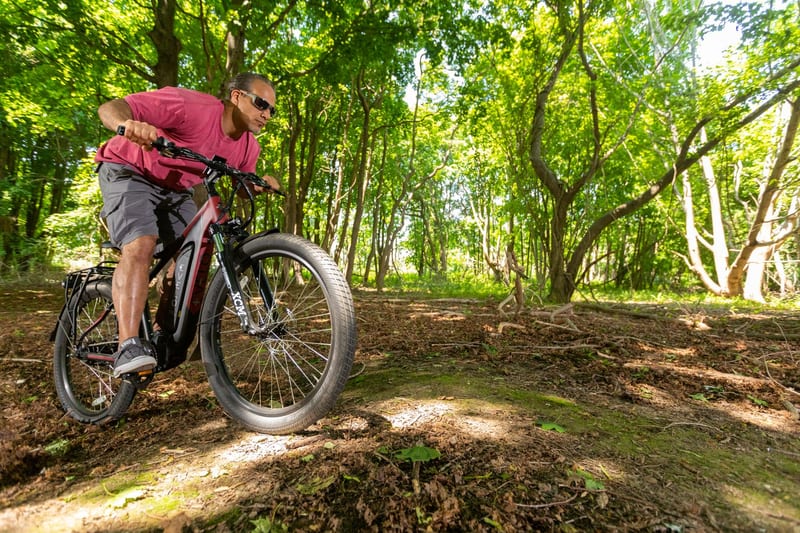
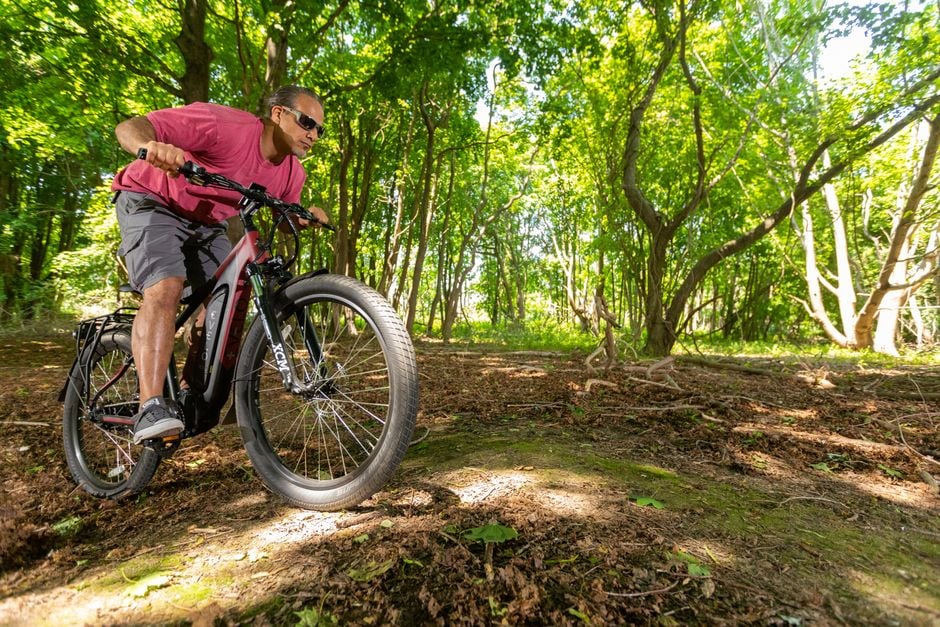
The first serious climb with a 15% gradient showed that the electric bike for mountains passes the test admirably. The 250W (nominal) mid-drive motor provided smooth, jerk-free traction. Unlike a hub motor, this setup allows using gears, which helps efficiently conquer long climbs without overheating the motor.

We climbed the steepest section in "sport" mode — the assistance felt powerful but natural. The bike didn't try to wrench the handlebars from your hands, as happens with cheap models. Thanks to the low center of gravity (the battery is mounted on the down tube), handling remained predictable even on loose soil.
Important nuance: on very steep sections (over 20%), we had to assist the motor by pedaling while standing. This is normal behavior for a production electric bike, as it is not a motorcycle. However, even in such conditions, fatigue is significantly less than on a regular mountain bike.
Handling on Descents and Technical Sections
The descent is the most critical part of any electric bike test on a trail. Here, the brakes and frame geometry play a crucial role. The test model was equipped with hydraulic disc brakes with four-piston calipers. They provided clear and predictable deceleration even on wet rocks.

The 140mm front and 130mm rear suspension travel allowed maintaining high speed on rough roads without losing control. The rear wheel didn't slide out on corners thanks to the wide 27.5x2.8 tires. ComfortShop experts advise paying special attention to the quality of brakes and shock absorbers if you plan aggressive mountain riding.
The motor's operation on descents deserves special mention. Most modern models have a regenerative braking function, but it is not a substitute for brakes. In our case, the regeneration was gentle, which did not interfere with speed control using traditional brakes. We did not notice any overheating even after a series of long descents.
Autonomy and Real Range
The manufacturer claims a range of up to 100 km on a single charge in mixed mode. In mountain conditions, this figure will always be lower. Our electric bike test on a mountain road showed the following results:
- "Eco" mode: 55 km (active pedaling, flat sections and small climbs).
- "Sport" mode: 38 km (intensive assistance on all climbs).
- "Turbo" mode: 25 km (maximum power, used only on the most difficult sections).
The 625 Wh battery showed stable operation. It is important to note that in cold weather (temperature around +5°C), the capacity decreased by approximately 10-15%, which is normal for lithium-ion batteries. For long mountain rides, we recommend having a spare power bank or planning a route with recharging options.
Comfort and Ergonomics During Long Rides
After four hours in the saddle, we can draw conclusions about ergonomics. The saddle turned out to be quite hard for long rides, which is typical for sport models. However, this is compensated by a comfortable riding position: the bottom bracket is low, providing stability on technical sections.
The 780mm wide handlebars provide excellent leverage for maneuvering, and the adjustable-angle stem allowed for a personalized riding position. Vibration on the handlebars is noticeable, but rubber grips and quality suspension smooth out most bumps. The off-road electric bike review showed that even on rocky roads, hands get significantly less tired than on a regular hardtail.
The control display is bright, and information about the charge level and speed is readable even in bright sunlight. The mode switching buttons are conveniently located, easily reachable with the thumb without taking your hands off the handlebars. This is important for safety during complex maneuvers.
Conclusion:
The electric bike test on a mountain road confirmed that modern models with a mid-drive motor can significantly expand the rider's capabilities. They allow conquering climbs that previously seemed insurmountable and enjoying descents without fear of brake overheating. ComfortShop reviewers recommend choosing a model with quality suspension and powerful brakes, as these components are responsible for safety in the mountains. If you are looking for a reliable companion for active recreation, such an electric bike will be an excellent investment in your adventures.
Frequently Asked Questions
Can an electric bike battery last a full day of mountain riding?
Usually no, if using a high level of assistance on steep climbs. For long mountain routes, it is recommended to take a spare battery or plan charging at intermediate stations.
Which type of motor is better for off-road — mid-drive or hub motor?
A mid-drive motor is significantly better for mountains, as it provides better weight distribution and conquers steep climbs more efficiently by working through the bike's transmission.
Can a regular mountain bike be used for an electric bike test on a trail?
No, a regular bike is not suitable, as an electric bike has a reinforced frame, more powerful brakes, and special suspension designed for greater weight and speed.
What power electric bike is needed for serious mountain trials?
For challenging mountain trails, a model with a motor of at least 500W is recommended, providing sufficient torque for climbs without system overheating.