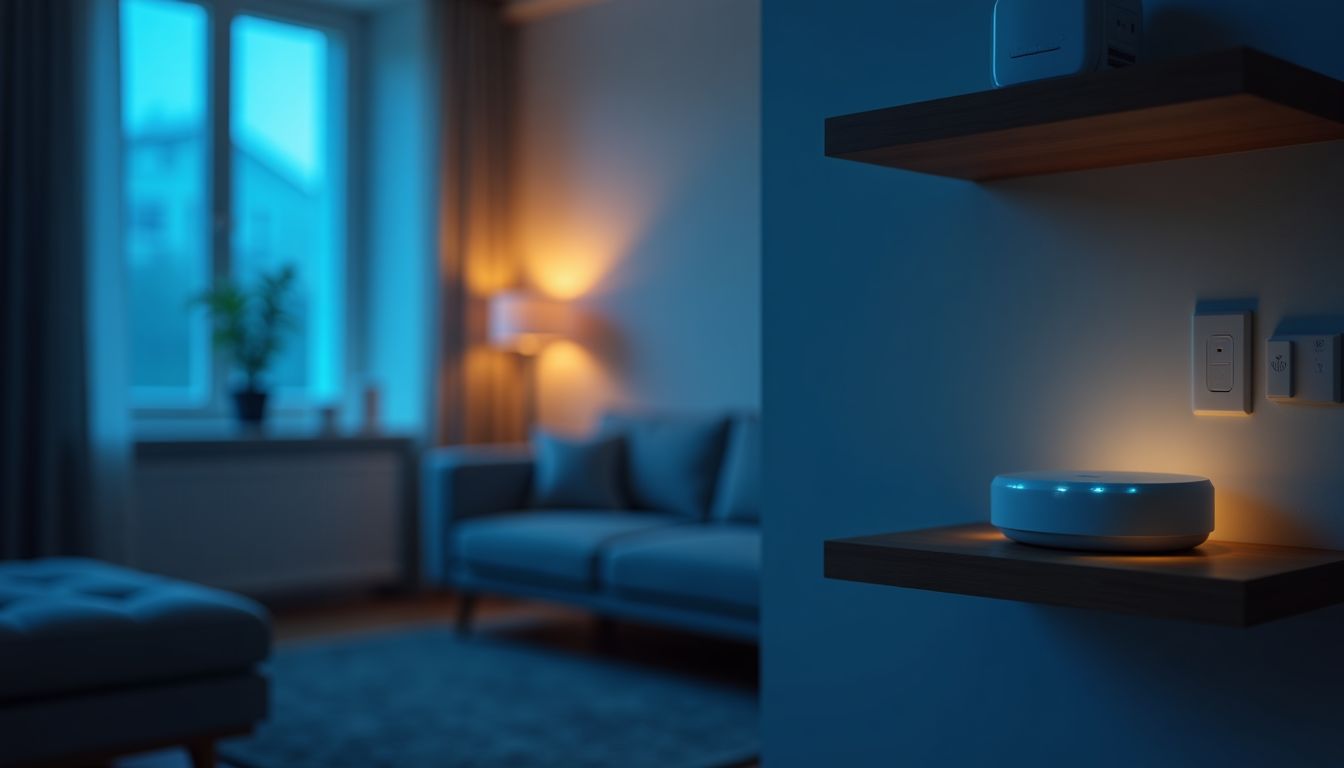
The concept of a smart home is becoming more accessible every year, transforming from a futuristic fantasy into everyday reality. However, on the path to home automation, users often face a fundamental choice: whether to limit themselves to individual voice assistants or invest in a full-fledged centralized system. This question is not just about budget, but also about the level of control, security, and future possibilities. Voice assistants like Alexa or Google Assistant offer a quick start and convenient hands-free control. Centralized systems, such as Home Assistant, promise complete independence and deep integration of all devices in a single space. Let's break it down in detail so your decision is informed and truly meets your needs.
? Table of Contents
Voice Assistants: Quick Start and Maximum Simplicity
Voice assistants from Amazon (Alexa), Google, and Apple (Siri) have become the most popular "gateways" into the world of smart homes. Their main advantage is intuitiveness. You don't need special technical knowledge to get started: by buying a speaker with an assistant, you can control compatible lamps, sockets, or, for example, a smart chicken coop door within minutes.
The operating principle is based on cloud technologies. Your voice command is picked up by the device, sent to the company's servers, processed, and only then executed. This ensures high stability and constant feature updates without your involvement. Most modern smart devices, like the Automatic Chicken Coop Smart Door, are specifically designed to work with these ecosystems, guaranteeing out-of-the-box compatibility.
However, simplicity has a downside — dependence on the internet, privacy, and the policies of large corporations. If the internet goes down or the company's servers are temporarily unavailable, your smart home can "act up." Furthermore, the logic of automations is often limited to pre-set scenarios (e.g., "Morning" or "Away from Home") without deep customization.
Centralized Systems: Full Control and Independence
At the opposite pole are centralized smart home management systems like Home Assistant, OpenHAB, Domoticz, or commercial solutions such as Hubitat. Their philosophy is complete autonomy and user control over all processes. Such a system typically runs on a local computer, a single-board computer (e.g., Raspberry Pi), or a dedicated hub on your home network.
The main advantage is offline operation and enhanced privacy.
All commands and automations are processed locally, so response times are faster, and your data never leaves your home. This is ideal for critical scenarios: automatic window closing during rain, heating control, or alarm systems. Home Assistant supports thousands of different devices from various brands, unifying them in a single interface, even if they use different communication protocols (Wi-Fi, Zigbee, Z-Wave).
However, this freedom comes with "sacrifices." Setting up such systems is often more complex, requiring technical skills and time. You may need to integrate devices yourself, write scripts for complex automations, and ensure the stability of the hardware. This is the path for enthusiasts who value flexibility over simplicity.
Comparison Table: Voice Assistant vs Centralized System
For clarity, let's summarize the key differences between the two approaches in a table. This will help you quickly assess which option best matches your lifestyle and technical background.
Comparison Criteria: Voice Assistant (Alexa/Google) | Centralized System (Home Assistant)
Ease of Setup: Very high, out-of-the-box | Medium/Low, requires technical knowledge
Entry Cost: Low (price of a speaker) | Higher (cost of hub/single-board computer)
Internet Dependence: Critical, functionality limited without it | Minimal, core functions work locally
Privacy: Data processed on company cloud servers | Data stays local, high level
Flexibility & Automation: Limited to pre-set scenarios | Virtually unlimited, can create complex logic chains
Device Compatibility: Limited to officially supported devices | Extremely broad, community support
Maintenance: Automatic updates, requires no attention | Requires manual updates and monitoring
Hybrid Approach: The Best of Both Worlds
Fortunately, the choice isn't always strictly "either-or." Modern technologies allow you to create hybrid systems that combine the advantages of both approaches. For example, you can deploy a local centralized system based on Home Assistant for reliable and complex automation of all critical processes in your home.
Then, integrate it with a voice assistant like Alexa or Google Assistant. This allows you to use convenient voice control for everyday tasks ("Alexa, turn on the kitchen light"), while having a system "brain" that operates autonomously and securely. Many devices, like the WiFi Electric Opener for Chicken Coop, which simultaneously supports Tuya (cloud), Alexa, and Home Assistant, are ideal for such a hybrid model.
Thus, you get the control and independence of a central system, along with the user-friendly interface of a voice assistant for the whole family. This path requires more effort for initial setup but yields optimal results.
What to Choose for Specific Tasks: A Practical Example
Let's consider the choice using a specific example of farm automation. Suppose you want to automate a chicken coop door with the Automatic Chicken Coop Smart Door. Your requirements: automatic opening at dawn and closing at dusk considering the season, phone notifications, and the ability to give a voice command "close the coop."
If you choose only a voice assistant, you can open and close the door by voice command. However, creating a smart automatic schedule tied to solar time might be limited or inconvenient. Furthermore, if the internet goes out, the automation won't work.
Using a centralized system (Home Assistant) allows you to create a precise, local scenario independent of the internet. You can set up automatic closing when a certain light level is reached or on a schedule, and receive detailed notifications. By integrating Home Assistant with Alexa, you add voice control for manual operations. This illustrates how, for complex, important tasks, a local system is more effective.

Conclusion:
The choice between a voice assistant and a centralized smart home system depends on your priorities. If you need maximum simplicity, a low entry cost, and aren't bothered by internet dependence — start with a voice assistant (Alexa or Google). It's a great way to get acquainted with automation. If you value full control, security, independence, and are willing to invest time in setup — a centralized system (Home Assistant) will be a powerful and reliable foundation for your smart home. For most, the optimal solution turns out to be a hybrid approach, where the central system provides the "brains," and the voice assistant provides a convenient "voice interface."