Modern active recreation, especially tourism and hiking, is hard to imagine without technological assistants. The choice between a classic fitness tracker and a functional smartwatch often becomes a dilemma for nature lovers. Both gadgets offer activity tracking, but their level of "awareness" of the environment and endurance differ significantly. This article will help you understand the key differences, advantages, and disadvantages of each type of device, so you can make an informed choice based on your needs and budget. We will compare in detail the capabilities aimed specifically at hiking challenges: navigation, weather monitoring, battery life, and durability.

? Table of Contents
Key Features for a Hiker: What to Look For
Before comparing device types, it's important to understand which features make a gadget a true assistant on a hike. Basic step and calorie counting are present in almost all models, but for serious outdoor trips, this is not enough.
The most important element is an accurate GPS module. It not only records your route but also, with pre-loaded maps, helps you navigate unfamiliar terrain. Additionally, modern devices for hiking are often equipped with additional sensors: an altimeter for measuring altitude, a barometer for tracking atmospheric pressure (which can signal weather changes), and a compass.
Battery life is also critical. A multi-day hike requires the gadget to work without daily recharging. Physical characteristics are equally important: case durability, impact resistance, water resistance (to ATM5 standard or higher), and display readability in bright sunlight.
Fitness Tracker for Hiking: Minimum Features, Maximum Savings
Fitness trackers are focused on basic activity and health tracking. They are lightweight, compact, and usually have very long battery life – from a week to a month. This can be attractive for infrequent outdoor trips or for those who don't want to invest a large sum.
Main limitations of trackers for hiking:
Most budget models do not have a built-in GPS, using a connection to a smartphone for route tracking. This quickly drains the phone's battery and makes the tracker useless if the smartphone's battery dies. The screen is usually small and monochrome, making it difficult to view maps or detailed information. Features like an altimeter, barometer, or compass are extremely rare in trackers and only found in top-tier models, which are already close in price to smartwatches.
Thus, a tracker is a good choice for urban walks or light day hikes where the main goal is to record general activity. For navigation and serious analysis of environmental conditions, its capabilities will be insufficient.
Smartwatch for Hiking: A Full-Fledged Tool on Your Wrist
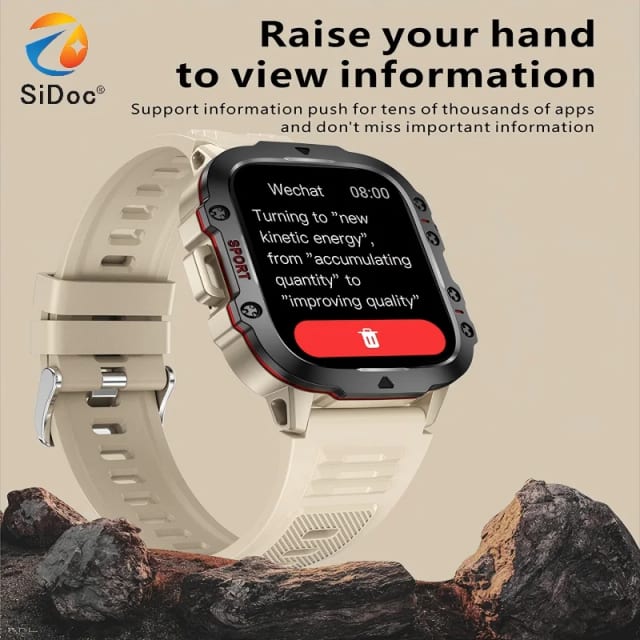
Smartwatches, especially models designed for sports and tourism, are no longer just accessories but complex, multifunctional devices. They combine the capabilities of an activity tracker, a navigator, and a weather station. A prime example is the North Edge Smart Watch Men Speedometer Sport Watch Hiking Altimeter Barometer Compass Fitness Tracker model.
Such watches are equipped with a full set of sensors: GPS/GLONASS for precise geolocation, an altimeter, a barometer, and an electronic compass. This allows real-time monitoring of ascent altitude, atmospheric pressure (predicting weather deterioration), and accurately determining cardinal directions. The large, usually color display, protected by durable glass, is easily readable in sunlight and allows viewing detailed information.
Battery life in such models is shorter compared to trackers, but thanks to a more powerful battery and energy-efficient modes, they can last several days in active mode and weeks in standby mode. An additional advantage is resistance to extreme conditions: impacts, dust, water, and low temperatures.
Comparison Table: Tracker vs Smartwatch
For clarity, let's summarize the key characteristics of the two device types in a table, focusing on the needs of a hiker.
| Feature | Fitness Tracker | Hiking Smartwatch (e.g., North Edge) |
|---|---|---|
| Navigation (GPS) | Often absent or via phone | Built-in GPS/GLONASS module |
| Altimeter/Barometer/Compass | Rare, only in expensive models | Full set of sensors (as in the mentioned model) |
| Battery Life | High (1-4 weeks) | Medium/High (3-10 days in active mode) |
| Screen | Small, often monochrome | Large, color, with backlight |
| Durability & Protection | Standard (water and dust resistant) | Enhanced (impact-resistant case, deep water resistance) |
| Price Range | Budget and mid-range | Mid-range and high |
Which is Better for Hiking: Tracker or Watch? Choosing by Goals
The final decision depends on the intensity, duration, and difficulty of your hikes, as well as your budget.
A fitness tracker is suitable for you if:
You take infrequent, short walks on well-maintained trails. Your priority is tracking general activity, sleep, and heart rate, rather than detailed navigation. You want to maximize the device's battery life and have a lightweight, unobtrusive gadget. Your budget is limited.
A hiking smartwatch is the choice of a serious hiker. It is necessary if you are going on multi-day hikes, ascents, or trips through unfamiliar or difficult terrain. When it's important to have a navigation and weather forecast source independent of your phone. When you are ready to invest in a reliable, functional tool that provides all the necessary data right on your wrist.
A model like the North Edge Smart Watch with its array of sensors is precisely such a solution – a watch designed for active recreation in the wilderness.

Conclusion:
The choice between a fitness tracker and a smartwatch for hiking comes down to a compromise between functionality, battery life, and cost. For light and undemanding outdoor activities, a tracker will suffice. However, for real hikes where independence, accurate navigation, and monitoring of environmental conditions are important, you should definitely consider a specialized smartwatch. It will become your reliable digital companion, helping you not only record but also safely plan your adventures in nature.