When choosing an air conditioner for a home, office, or special room, many face a dilemma: inverter or conventional (on/off) unit? These are fundamentally different technologies that affect comfort, energy savings, and system longevity. Understanding how they work will help you make an informed decision and buy the model that best suits your needs and budget. In this article, we will compare both types in detail, examine their advantages and disadvantages, and provide specific recommendations for different usage scenarios.
? Table of Contents
- Operating Principle: Fundamental Difference
- Advantages and Disadvantages of Conventional (on/off) Air Conditioners
- Advantages and Disadvantages of Inverter Air Conditioners
- Comparison Table: Inverter vs Conventional Air Conditioner
- What to Choose: Practical Recommendations for Different Situations
- Specialized Solutions: Example of an Inverter Model
- Conclusion:
Operating Principle: Fundamental Difference
The main difference between a conventional and an inverter air conditioner lies in the way the compressor — the "heart" of any split system — operates. A conventional (start-stop) air conditioner works on the "on/off" principle. When the room temperature reaches the set value, the compressor completely stops. When the air heats up or cools down again by 2-3 degrees, the compressor starts at full power to quickly compensate for the difference.
Inverter technology fundamentally changes this approach. It provides smooth power regulation of the compressor using a frequency converter (inverter). After reaching the set temperature, the compressor does not turn off but only reduces its speed, maintaining a precise climate constantly. This is similar to regulating a car's speed: a conventional unit constantly accelerates and brakes sharply, while an inverter one smoothly drives at the required speed.
Advantages and Disadvantages of Conventional (on/off) Air Conditioners
Conventional models were the market standard for a long time and remain popular due to their lower initial cost. Their main advantage is affordability. They also usually have a simpler design, which can simplify their maintenance and repair.
Main disadvantages of conventional air conditioners:
High energy consumption: Constant on/off cycles at full power are the most energy-intensive operating mode. This leads to significantly higher electricity bills compared to inverters.
Less comfort: Temperature fluctuations of 3-5 degrees from the set point are noticeable to the body. Additionally, each compressor start is accompanied by noticeable noise from the outdoor unit.
Load on the network and components: Starting currents at each start create additional load on the electrical network and the compressor itself, which can reduce the overall lifespan of the equipment.
Advantages and Disadvantages of Inverter Air Conditioners
Inverter models represent a new generation of technology focused on efficiency and comfort. Their main strength is energy savings, which can reach 30-40% compared to conventional counterparts with prolonged use. This happens due to the absence of energy-intensive starts and operation at the required power.
Key advantages of inverter systems:
Precise and stable climate: Temperature is maintained with an accuracy of 0.5-1°C, eliminating the feeling of "cold" or "hot" air bursts. Smooth operation also ensures minimal noise levels from both the indoor and outdoor units.
Fast reaching the set mode: An inverter air conditioner operates at a power higher than nominal at startup, allowing it to cool or heat the room to the set parameters very quickly.
Gentler load and longer service life: Smooth start and the absence of constant on/off cycles reduce compressor wear, which positively affects the durability of the entire system.
The main disadvantage of inverter air conditioners remains their higher price. They can also be more sensitive to voltage instability in the network, which may require installing a stabilizer.
Comparison Table: Inverter vs Conventional Air Conditioner
| Criterion | Conventional (On/Off) | Inverter |
|---|---|---|
| Operating Principle | Cyclic on/off of the compressor | Smooth power regulation of the compressor |
| Energy Efficiency | Lower (higher operating cost) | Higher (savings up to 30-40%) |
| Temperature Accuracy | ±2-3°C (noticeable fluctuations) | ±0.5-1°C (stable) |
| Noise Level | Higher (due to periodic starts) | Lower (smooth operation) |
| Equipment Cost | Lower | Higher |
| Durability | Average (due to wear during starts) | Higher (with quality installation) |
| Speed of Reaching Set Temperature | Average | High (operates at increased power at startup) |
What to Choose: Practical Recommendations for Different Situations
The choice between an inverter and a conventional air conditioner depends on the budget, usage pattern, and room characteristics.
Choose a conventional air conditioner if:
- The budget is limited and equipment is needed urgently.
- The air conditioner is planned for occasional use (a few days a year in hot weather).
- The room is non-residential (warehouse, workshop), where temperature accuracy and noise are not critical.
It is worth investing in an inverter air conditioner if:
- The equipment will be used frequently or constantly (in a bedroom, children's room, living room, office).
- Comfort is important: stable temperature and low noise level (especially at night).
- You are willing to pay more upfront to save on electricity in the long term.
- A heating function is needed during the off-season — inverters are more efficient at low outdoor temperatures.
Specialized Solutions: Example of an Inverter Model
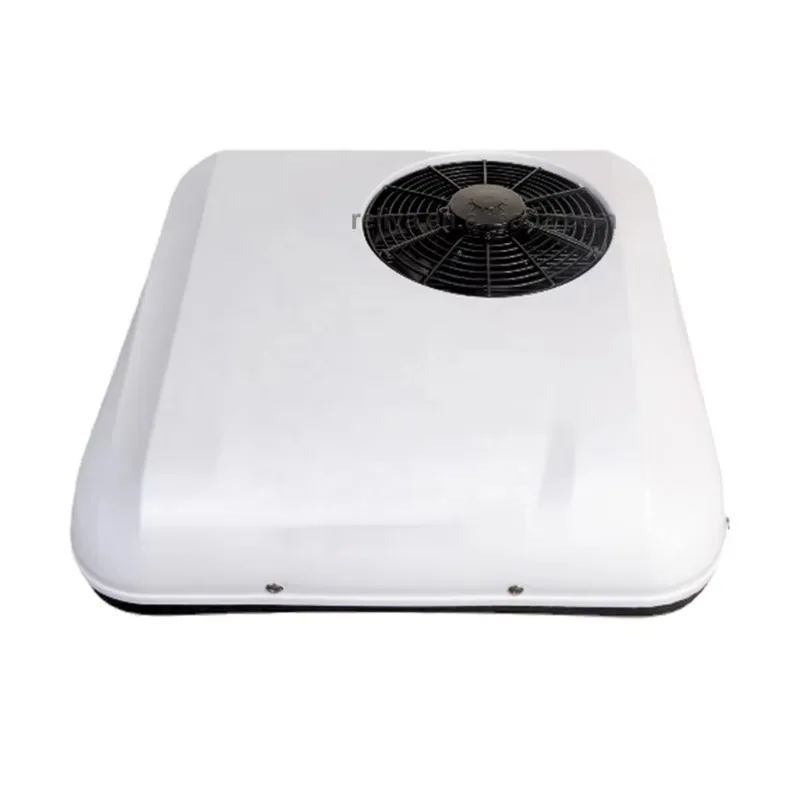
For non-standard tasks, such as ensuring comfort in a motorhome, camper, truck cabin, or small technical room, there are special models. A striking example is the 12000Btu Quiet Caravan RV Camping Conditioning Aircon Semi Truck Cabin Ceiling Mounted Mini AC Inverter Air Conditioner.
This ceiling-mounted inverter model combines the advantages of the technology in a compact design. It provides efficient cooling/heating with minimal energy consumption from the onboard network, which is critically important for autonomous travel. Smooth inverter operation guarantees low noise, and the ceiling placement saves precious space in a small room. Such an air conditioner is ideal for mobile homes or a driver's workspace, where energy efficiency and comfort are important.
Conclusion:
If the air conditioner is needed for rare use and your priority is minimal initial cost, a conventional (on/off) model will be an adequate choice. However, for constant operation in residential or office spaces, it is definitely worth choosing an inverter air conditioner. Its higher price is quickly recouped through significant savings on electricity, and the continuous comfort, quietness, and longer service life make this investment profitable and smart. For special conditions, such as campers or trucks, inverter technologies are the only correct choice due to their energy efficiency and adaptability.