Smartphone and tablet users often face the problem of a shortage of outlets, especially in a car. The desire to save money leads to the search for budget solutions, and marketplaces like AliExpress offer a huge selection of cheap USB chargers. However, the low price naturally raises questions about the reliability and safety of such gadgets. Is it worth risking a charger that costs a few dollars, which will power your expensive smartphone or tablet? In this article, we will take a detailed look at the risks associated with cheap chargers and provide practical recommendations for choosing a safe device, using the example of combined car panels such as the Waywe 5 Gang 12V with USB charging.

? Table of Contents
The World of Cheap Chargers: What Does the Low Price Hide?
The attractive price of USB chargers from AliExpress, which can be 5-10 times lower than branded counterparts, is due to a number of factors. First and foremost, it is the use of the cheapest components: low-quality capacitors, transformers, and circuit boards that do not meet any standards. Such components quickly fail due to overheating or voltage surges.
The second critical aspect is the lack of proper quality control and basic engineering calculations. Cheap chargers often lack proper insulation, protection against overheating, short circuits, or overvoltage. This makes them not just unreliable, but potentially dangerous electrical appliances.
Buying such a charger is like playing roulette. In one case, it might simply charge your device slowly; in another, it could cause a fire due to overheating or damage your smartphone's battery with unstable voltage.
Main Risks and Dangers for Devices
Using low-quality chargers poses specific threats to both the gadget and the user. Understanding these risks will help you assess the possible consequences of saving money.
Battery Damage Due to Unstable Voltage:
Modern lithium-ion and lithium-polymer batteries are demanding regarding charging conditions. A quality charger has a chip that stabilizes the output voltage and current according to standards (e.g., 5V/2A, 9V/1.67A for QC). Cheap counterfeits often lack a proper controller, supplying the device with either undervoltage, overvoltage, or "dirty" voltage with ripples. This leads to battery overheating, rapid capacity loss, and in the long term, swelling and complete failure.
Another common problem is the lack of short-circuit protection. In the event of an internal short circuit in the charger or cable, a quality device should cut off the power. A cheap counterpart will not do this, which can lead to damage to the charging port on the smartphone or even its motherboard. Repairing such damage often costs much more than the savings on an original charger.
Threat to Life and Property Safety
The most serious risk is fire hazard and the risk of electric shock. Inadequate insulation of the transformer and other components inside the case can lead to a breakdown to the case. If the charger has a metal case, as in some car models, this poses a direct threat to the user.
Overheating is the main enemy of cheap electronics. The lack of thermal protection and the use of non-flame-retardant materials can cause the charger to catch fire. This is especially dangerous in a car, where the device remains powered for a long time, or at home at night. Incidents involving cheap power supplies catching fire are not uncommon, as evidenced by numerous reports online.
Therefore, when choosing a charger, especially for permanent use in a car, safety should be the top priority. It is better to opt for proven solutions that have safety certificates and are built to handle long-term loads.
How to Choose a Safe Charger: Key Criteria
To minimize risks, when choosing a USB charger, even on AliExpress, you should pay attention to specific signs of quality. The first rule is to avoid the cheapest offers with missing or illegible technical specifications.
What to Definitely Pay Attention To:
- Availability of Certificates: The product description should mention international safety standards such as CE, RoHS, FCC. Although these can be faked on marketplaces, their presence is a minimum filter.
- Clear Technical Specifications: The output voltage and current should be clearly stated (e.g., 5V/2.4A, 12V/1.5A). Devices supporting fast charging (Quick Charge, Power Delivery) should have the corresponding logos.
- Reviews and Photos: Carefully study the reviews, especially those where buyers add real photos of the product, disassemble it, or test it with a tester. Pay attention to complaints about overheating or non-working ports.
- Case Material: High-quality plastic or anodized aluminum (as in the Waywe panel) dissipates heat better than cheap plastic.
Overview of Combined Solutions: The Waywe 5 Gang Example
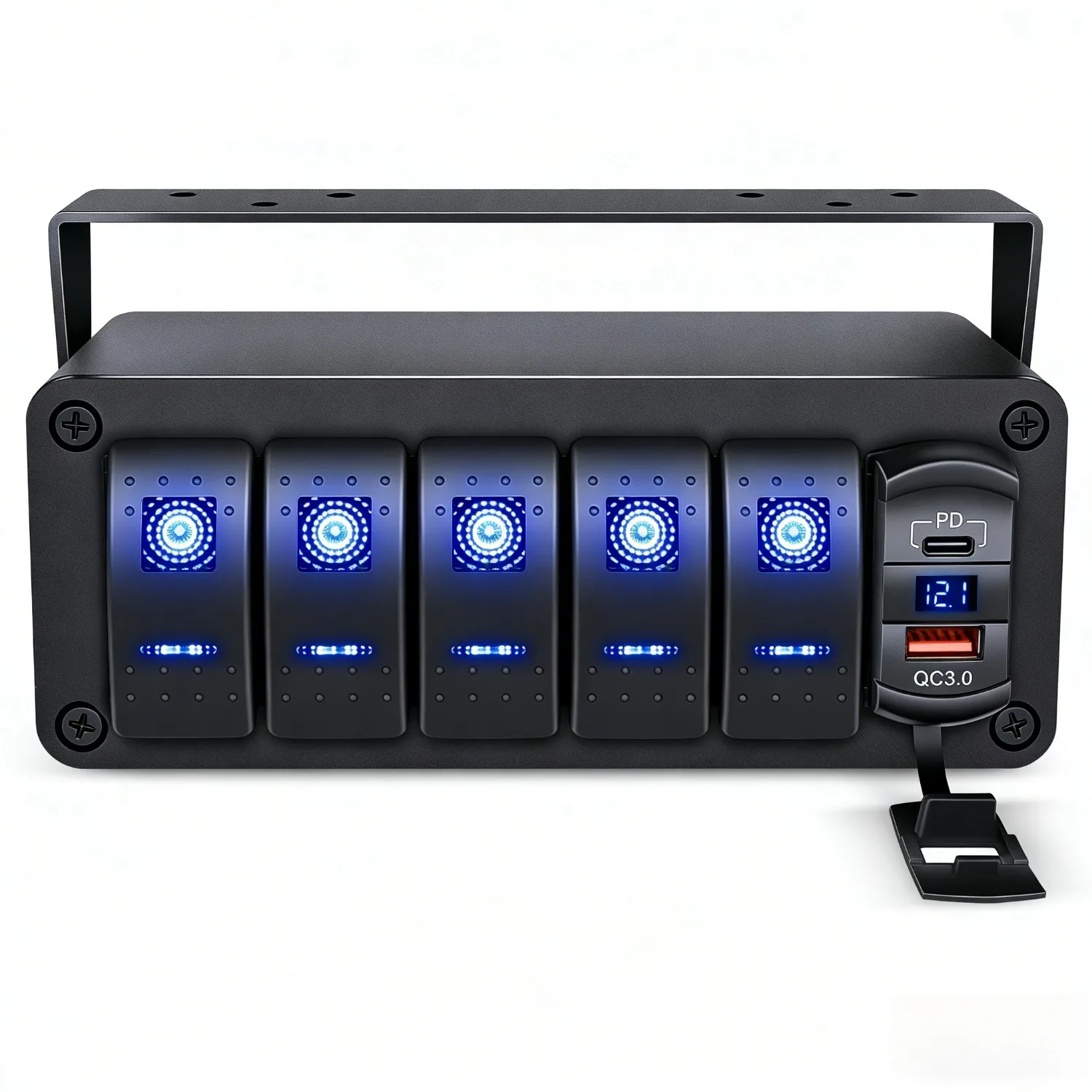
Car needs often require a comprehensive approach. This is where combined panels come to the rescue, which combine cigarette lighter sockets, USB ports, and voltage control. Let's consider the Waywe 5 Gang 12V model with a USB charger and voltmeter as an example.
This device differs from typical "Chinese" chargers in that it is not just a power supply, but a module for installation in a car panel. The aluminum construction promotes better heat exchange, which already reduces the risk of overheating. The presence of a built-in voltmeter is a useful function for monitoring the condition of the car's on-board network.
An important advantage of such modular solutions is the possibility of high-quality installation and connection to the car's standard wiring via a fuse, rather than just through the cigarette lighter socket. This ensures reliable contact and protection. The USB module in such a panel, as a rule, has a better component base than pocket chargers, as it is designed for continuous operation. However, even here, you should check reviews for the specific model regarding the stability of the USB ports, especially with the QC3.0 or PD fast charging function.
Practical Safety Check of a Charger
If you have already purchased a device, there are simple ways to preliminarily assess its safety. These steps do not guarantee the complete absence of defects, but they will help weed out clearly dangerous specimens.
The first test is organoleptic. Smell the new charger. A sharp smell of cheap plastic or chemicals may indicate low-quality materials. Assess the weight: a device that is too light often indicates the absence of a proper transformer and a minimum of metal elements inside.
The second stage is a performance check. Connect the charger without a load for 15-20 minutes and carefully touch it. Strong heating in standby mode is a bad sign. Then connect an inexpensive device (e.g., an old smartphone) to it and charge it, monitoring the heating of both the charger and the gadget. An extremely hot case is a reason for immediate disconnection.
The best way to check is to use a USB tester, which will show the actual output voltage and current. The stability of these indicators under load is a key indicator of quality. If the voltage fluctuates significantly or drops below 4.8V when a device is connected, using such a charger is dangerous.
Conclusion:
Cheap USB chargers from AliExpress are often a lottery, where the stake could be the safety of your gadget, car, or even home. Saving a few dollars is not worth the potential risks of damaging expensive equipment or causing a fire. When choosing a charger, give preference to models with clear specifications, certificates, and verified reviews. Combined and modular solutions, such as the Waywe 5 Gang panel, often prove to be more reliable due to better design and materials. Invest in safety — choose quality chargers from reputable sellers.