Do you often leave your charger plugged into the outlet, even when your phone or laptop is already fully charged? This question sparks a lot of debate among gadget users. Some believe it is completely safe and convenient, while others fear fire, electricity waste, and rapid wear of the adapter itself. The truth, as always, lies somewhere in between and depends on the quality of the device, its condition, and operating conditions. In this article, we will thoroughly analyze the myths and facts surrounding the question of whether it is safe to leave a charger in an outlet without a phone, and examine how modern technologies, such as GaN, are changing the rules of the game. Using the powerful and safe UGREEN 100W/65W GaN Charger 6 in 1 as an example, we will show what to look for for worry-free use.
? Table of Contents
Charger Power Consumption in Standby Mode: Waste or Trifle?
One of the main fears is that a charger left in the outlet will rack up huge electricity bills. In reality, the energy consumption of a modern, high-quality charger in idle mode (when nothing is connected to it) is minimal. This is the so-called "phantom" consumption, which is typically between 0.1 and 0.5 W.
For comparison: an old charger with an iron-core transformer could consume 1-2 W. However, even these figures are not critical. If we take the maximum of 0.5 W, over a year of continuous connection to the outlet, such an adapter would consume about 4.38 kWh. At current rates, this is mere pennies. The main issue here is not about saving money, but about principle and safety.
Modern chargers, especially those using GaN (gallium nitride) technology, like the UGREEN 100W/65W GaN Charger, are even more efficient. They have better power management circuits that minimize energy losses both during operation and in standby mode. Thus, from an energy consumption standpoint, leaving a quality charger in the outlet is not a budget disaster.
Fire Safety of Chargers: Main Risks
This is where the greatest danger lies. The mere fact that an adapter is plugged into an outlet does not cause a fire. Risks arise from other factors related to the quality and condition of the device. Cheap, uncertified chargers from Aliexpress or markets are the prime candidates for problems. Their components often do not meet standards, the insulation is weak, and protection circuits are absent.
Main causes of charger fires:
The first is overheating due to low-quality components or overload. If a charger is rated for 10 W and you try to charge a laptop with it, it will operate at its limit and get very hot. The second cause is mechanical damage: bent or frayed wires, a cracked casing through which dust or moisture can enter. The third is problems with the electrical grid: voltage surges that can damage the device.
High-quality chargers, such as the UGREEN 100W/65W GaN Charger, have a whole arsenal of protection: against overheating, overload, short circuits, and overvoltage. Their components are of higher quality, and the casing is designed for efficient heat dissipation. Such devices are much more resistant to prolonged operation and adverse conditions. However, even they should not be left under constant voltage in rooms with high humidity (bathroom) or dust.
Impact on Charger Lifespan: Does the Adapter Wear Out Faster?
The electronic components of any device have a certain service life, which depends on temperature conditions and load cycles. Constant exposure to voltage, even without a load, creates minimal stress on capacitors and other circuit elements. Theoretically, this can accelerate their "aging," but in practice, for a quality product, this impact is minimal and is rarely the cause of failure.
More harmful is the regular mechanical plugging/unplugging from the outlet, especially if done abruptly by the cable. This loosens the contacts both in the charger itself and in the outlet, which can eventually lead to breakage. Therefore, from a mechanical resource standpoint, leaving a stationary charger, like the UGREEN 6-in-1 desktop model, in the outlet might even be better than removing and inserting it daily.
The real enemy of lifespan is thermal stress. If a charger always operates at its limit and gets very hot, its components degrade faster. High-quality adapters with GaN technology generate significantly less heat compared to traditional silicon solutions at the same power, which positively impacts durability even with prolonged use.
Myths About Chargers That Need Debunking
There are many myths surrounding chargers that have persisted for decades. Let's break down the most common ones. Myth one: "A charger in an outlet without a phone gives an electric shock and is dangerous for children." In reality, the power supply unit itself does not produce voltage at the output if nothing is connected to it. Danger can only arise in the case of serious damage to the casing and insulation, which is unlikely for an intact device.
Myth two: "It can 'remember' the charge and transfer it back to the grid." This is absolute nonsense from a physics standpoint. An adapter is merely a converter of the grid's alternating voltage to a low direct voltage for the device. It does not store anything. Myth three: "A device unplugged from the outlet consumes zero energy." This is true, but it's worth remembering that the very process of plugging/unplugging creates micro-arcs that gradually wear out the outlet contacts.
Modern chargers, especially premium ones, are designed for continuous operation. They undergo rigorous safety and durability tests. It is important to distinguish between outdated concerns and real risks, which are mainly associated with low-quality products.
UGREEN 100W/65W GaN Charger 6 in 1: An Example of Modern Safety and Smart Design
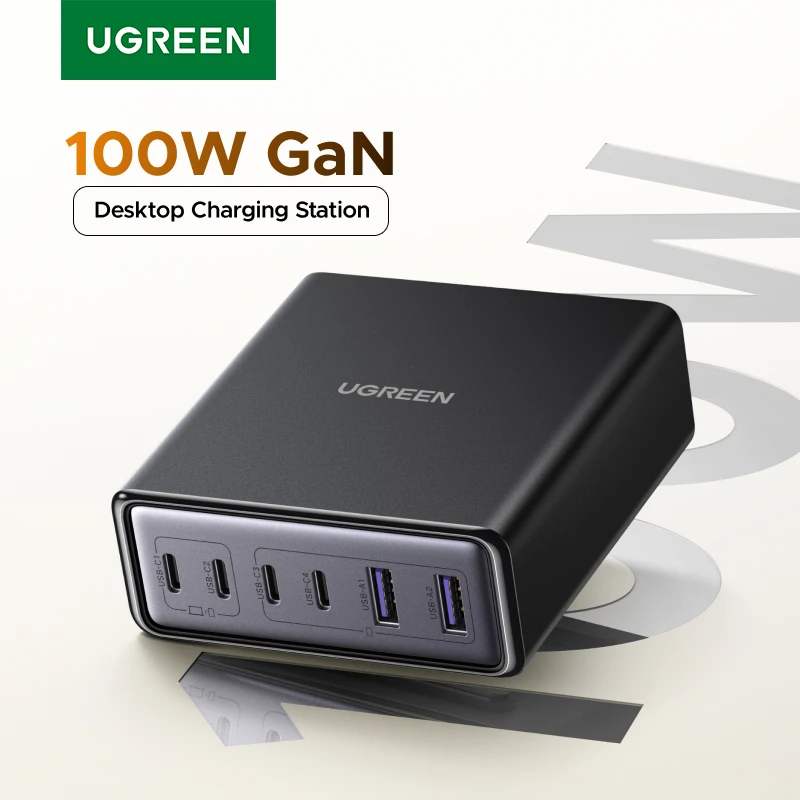
Let's look at how safety principles are implemented in modern powerful devices using the UGREEN 100W/65W GaN Charger 6 in 1 as an example. This desktop charger combines six ports (including USB-C and USB-A) and can simultaneously charge a laptop, tablet, and phone at full speed. Its design is oriented towards permanent connection to the outlet as a stationary charging station.
Key safety technologies of the UGREEN GaN Charger:
GaN (gallium nitride) technology allows for creating more compact and efficient chargers that generate up to 40% less heat compared to conventional ones. Less heat means less stress on components and a lower risk of overheating. The device has a full set of protections: against overheating (when the temperature reaches a critical point, the charger automatically shuts off), overvoltage, overload, and short circuits.
Its casing is made of fire-resistant PC (polycarbonate) material and features an intelligent Dynamic Power Distribution system. It automatically distributes power among connected gadgets, preventing overload of individual circuits. Such characteristics make it one of the safest options for continuous use without the need to constantly unplug it from the outlet.
Conclusion:
Leaving a high-quality, certified charger in an outlet without a phone is relatively safe in terms of energy consumption and the lifespan of the adapter itself. The main risks are not related to the fact of it being in the outlet, but to the use of cheap, low-quality models, their mechanical damage, or operation in unfavorable conditions. For maximum peace of mind, it is recommended to use modern chargers with GaN technology and a full set of protections, such as the UGREEN 100W/65W GaN Charger 6 in 1, which is designed as a reliable stationary station. The wisest practice is to unplug any electronics from the outlet during extended absences or in case of thunderstorm warnings.