Article Contents
- Why Wi-Fi at the dacha is a weak point, and what to do about it
- How video surveillance for the dacha with a SIM card works
- Review of a 4G camera for the dacha: key features to pay attention to
- Wireless camera for the dacha without Wi-Fi: autonomy and power
- How to choose a SIM card and plan for a video surveillance camera
- Connection and setup: what you need to know before starting
- Conclusion:
Why Wi-Fi at the dacha is a weak point, and what to do about it

Classic Wi-Fi cameras work great in city apartments, where the router is always nearby and the internet is stable. But at the dacha, the situation is completely different: there is often no wired internet, and the access point is limited to a smartphone. In such conditions, standard equipment becomes useless, because without a constant network connection, the camera cannot transmit video.
That is why more and more owners of country houses are paying attention to autonomous solutions. A 4G camera for the dacha without internet is a device that works through the mobile network, using a regular SIM card. It does not need a router, fiber optics, or any other wired connection.
Based on an analysis of specifications, ComfortShop recommends considering such cameras as the primary option for seasonal dacha security, construction sites, or remote warehouses where stable internet is simply not available.
How video surveillance for the dacha with a SIM card works
The operating principle is extremely simple: a SIM card from any Ukrainian operator is inserted into a dedicated slot, after which the camera automatically connects to the 3G or 4G mobile network. The video stream is transmitted to a secure cloud server or directly to a mobile app on your smartphone.

The main advantage of this approach is complete independence from local infrastructure. You do not need to lay cables, configure a router, or sign a contract with an internet provider. You only need to provide the camera with power — from an outlet, battery, or solar panel.
Key system components
- SIM card slot — supports standard nano/micro format cards.
- 4G LTE module — ensures fast video transmission in high resolution.
- microSD slot — local storage of recordings in case the network is unavailable.
- Built-in battery — for models that operate without constant power.
It is also worth mentioning that a SIM card for a video surveillance camera does not necessarily have to be tied to an expensive plan. For real-time video viewing, a package with a few gigabytes of traffic per month is sufficient, while continuous recording will require a larger volume.
Review of a 4G camera for the dacha: key features to pay attention to
Before purchasing, it is important to understand which parameters determine the quality of the device's operation. A review of a 4G camera for the dacha should start with the sensor resolution, since it directly affects image clarity.

Most modern models offer Full HD 1080p, which is quite sufficient for recognizing faces and license plates at a distance of up to 10–15 meters. More expensive solutions support 2K or even 4K, but they require more traffic and a faster connection.
Night vision is an essential element for suburban use.
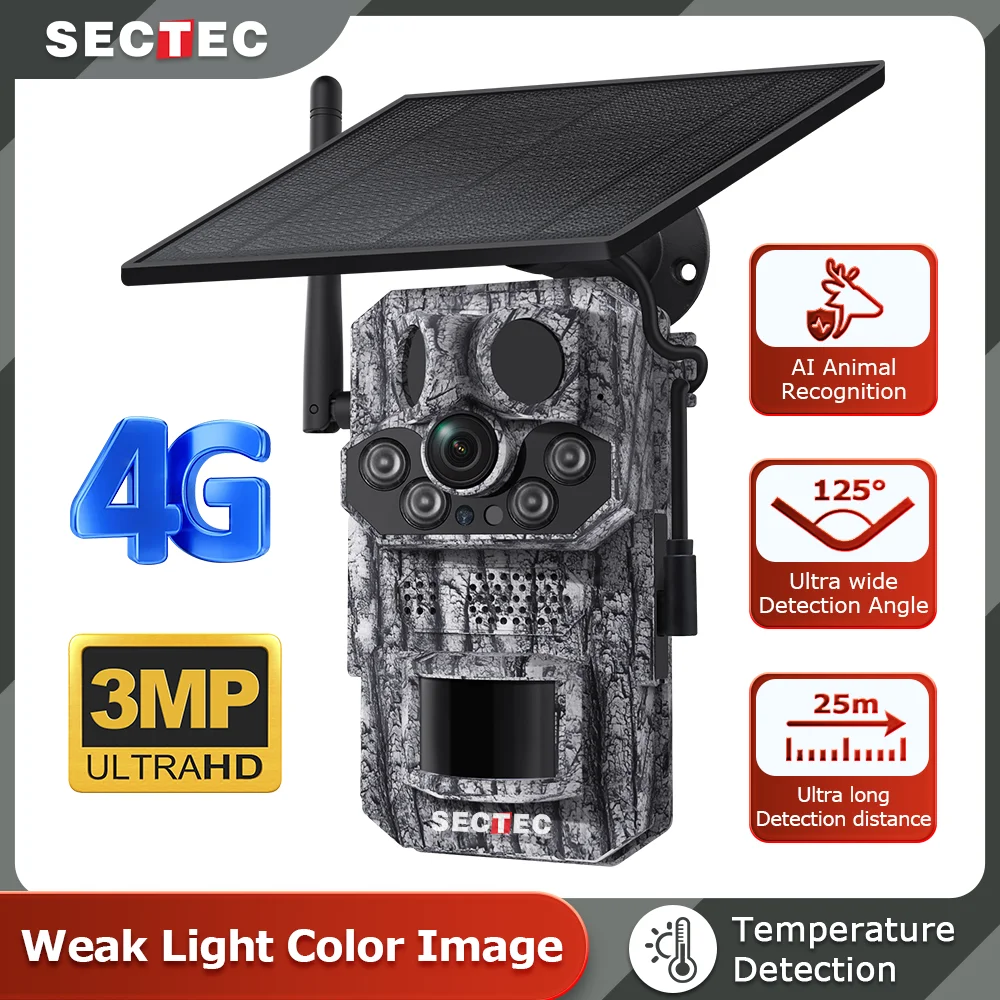
Infrared illumination allows you to see what is happening in complete darkness. Pay attention to the stated night vision range: for a dacha, 10 to 30 meters is optimal. Motion sensors are also useful, as they activate recording only when needed, saving traffic and battery power.
Additional features
- Two-way audio — you can talk to a courier or scare off uninvited guests.
- Dust and moisture protection — IP65 or IP66 rating allows operation in rain and snow.
- PTZ control — a pan-tilt camera expands the viewing area up to 360 degrees.
- Solar panel included — makes the camera fully autonomous.
After analyzing open sources, the ComfortShop editorial team notes that models in the mid-price segment with a Full HD sensor, IR illumination, and microSD support up to 128 GB offer the best price-to-functionality ratio.
Wireless camera for the dacha without Wi-Fi: autonomy and power
When it comes to a dacha where electricity may be unstable or completely absent, autonomy takes center stage. A wireless camera for the dacha without Wi-Fi is most often a model with a built-in battery with a capacity of 5000 to 10000 mAh.
Such a device can operate on a single charge from several weeks to several months, depending on the intensity of recording. If the camera is activated only by the motion sensor rather than recording continuously, power consumption is significantly reduced.
For maximum independence, we recommend paying attention to models that come with a solar panel. In this case, the camera charges during the day and operates around the clock without human intervention. This is especially convenient for those who visit the dacha only once every few weeks.
How to choose a SIM card and plan for a video surveillance camera
Choosing the operator and tariff plan is no less important than choosing the camera itself. A SIM card for a video surveillance camera must provide stable coverage specifically in your area, so it is worth checking operator coverage maps before purchasing.
Please note that the camera consumes traffic only when you are viewing video in real time or when it is uploading recordings to the cloud. If you use local storage on a microSD card and review the archive only when needed, costs will be minimal.
The recommended minimum for comfortable use is 5–10 GB of traffic per month.

This is enough for periodic video viewing in 720p or 1080p quality. For continuous remote monitoring in high quality, it is better to choose an unlimited plan or a package of 30 GB or more.
Connection and setup: what you need to know before starting
Most modern 4G cameras are configured through a mobile app within 5–10 minutes. You simply insert the SIM card, turn on the device, scan the QR code, and follow the prompts on your smartphone screen.
It is important to make sure that the SIM card does not have a PIN code, otherwise the camera will not be able to connect to it. You should also disable services that may block data transmission, such as automatic USSD requests or advertising messages.
According to the recommendation of the ComfortShop editorial team, before final installation of the camera, it is worth testing it at different points of the property to find the location with the best mobile network signal. This will help avoid problems with video freezing or connection loss in the future.
Висновок:
A 4G camera for the dacha without internet is a practical solution for those who want to monitor their suburban property without complex network setup. It works through mobile communication, does not require a router, and provides video viewing from anywhere in the world. When choosing a model, pay attention to resolution, night vision, autonomy, and compatibility with Ukrainian operator plans. ComfortShop recommends starting with mid-price segment models with a Full HD sensor and microSD support, which offer an optimal balance of price and quality.
Frequently Asked Questions
How does a 4G camera for the dacha work without internet and Wi-Fi?
Such a camera uses the mobile network of a telecom operator through an installed SIM card, so it does not need home internet or a router.
Which SIM card should I choose for a video surveillance camera at the dacha?
It is best to choose a plan with a large mobile internet package (from 10 GB per month) from an operator that has stable 4G coverage specifically in your area.
Can I view video from a wireless camera at the dacha from a smartphone?
Yes, the video is available through the manufacturer's proprietary mobile app, which connects to the camera via the internet from anywhere in the world.
What disadvantages does a 4G camera for the dacha have compared to Wi-Fi models?
The main disadvantage is the monthly fee for mobile traffic, as well as the dependence of connection quality on the stability of the operator's signal in rural areas.