Solar power banks with an integrated photovoltaic panel have become a real lifesaver for outdoor enthusiasts, travelers, and those seeking energy independence. They promise an endless source of energy directly from the sun, which is especially appealing during long hikes or when there is no access to a power outlet. However, when buying such a gadget, it's easy to fall into the trap of marketing slogans and technical nuances that can significantly reduce the expected effect. This article will help you understand the key parameters and hidden details so that your decision on how to choose a solar power bank is informed and correct. We will also look at a practical example of a multifunctional device that combines not only a power bank with a solar panel but also a powerful lighting fixture.
? Table of Contents
Solar Panel Power: Is There Enough Sun for Charging?
The first and most important parameter to pay attention to is the power of the solar panel built into the case. It is measured in watts (W) and directly affects the charging speed of the power bank's battery. Models with panels rated at 1-3 W are often found on the market, which look attractive in terms of price but have a serious drawback.
Such power is usually insufficient for quickly restoring capacity, especially under non-ideal insolation conditions (cloudiness, angle of incidence). Charging a large battery can take a whole day or even more, making the process impractical. For serious use, it is recommended to consider models with a panel of 5 W or higher. It is important to understand that the stated power is only achieved under ideal laboratory conditions: direct sunlight at a right angle on a sunny day.
The real performance of a solar panel in field conditions is always lower than the nominal rating.
Therefore, you should plan with a margin. Also, pay attention to the type of photocells: monocrystalline panels are usually more efficient than polycrystalline ones, but they are also more expensive. Consider this parameter when deciding how to choose a solar power bank for regular off-grid use.
Power Bank Battery Capacity: Balancing Autonomy and Weight
The second pillar on which the device's efficiency rests is the capacity of its built-in battery. It is measured in milliamp-hours (mAh) or watt-hours (Wh). Of course, the larger the capacity, the more times you can charge your smartphone or other gadget. However, this is where the first "pitfall" lies.
A large capacity (e.g., 20,000-30,000 mAh) means a heavier and bulkier device. But the main thing is that such a battery is very slow to charge from a small solar panel. An imbalance can occur: a 2-3 W panel simply won't be enough to effectively fill a 20,000 mAh battery in a reasonable time. Therefore, when choosing, you need to find a harmonious ratio: a sufficiently powerful panel for real charging and sufficient battery capacity for your needs.
For one or two full smartphone charges in the field, a 10,000 mAh power bank with a quality 5 W solar panel is often enough. Also, remember the actual output charge: some energy is lost as heat and voltage conversion, so from the stated 10,000 mAh, you will get approximately 6-7 thousand at the output.
Ports, Features, and Protection: What Else to Look For?
In addition to the two main parameters, when choosing a power bank with a solar panel, it is critically important to evaluate its equipment and protection. Make sure the device has modern ports for charging the power bank itself (input) and for connecting your gadgets (output). It is desirable to have a USB-C port for fast charging and a standard USB-A port.
A very useful option is the presence of a built-in flashlight or, even better, a work light. This turns the power bank into a real multi-tool for camping or an emergency kit. Also, pay attention to the dust and water protection class (IP). For field use, the IPX4 standard (protection against splashes from any direction) is considered minimally sufficient. If you plan to take the device on heavy hikes, it is better to look for a model with IP65 or higher.
Don't forget about the display: a quality device should have clear indicators for the battery charge level and the solar charging process. This will help you plan your energy usage. Also, assess the build quality of the case and the reliability of the opening elements (port covers).
Example of a Combination: A Work Light with Power Bank Function
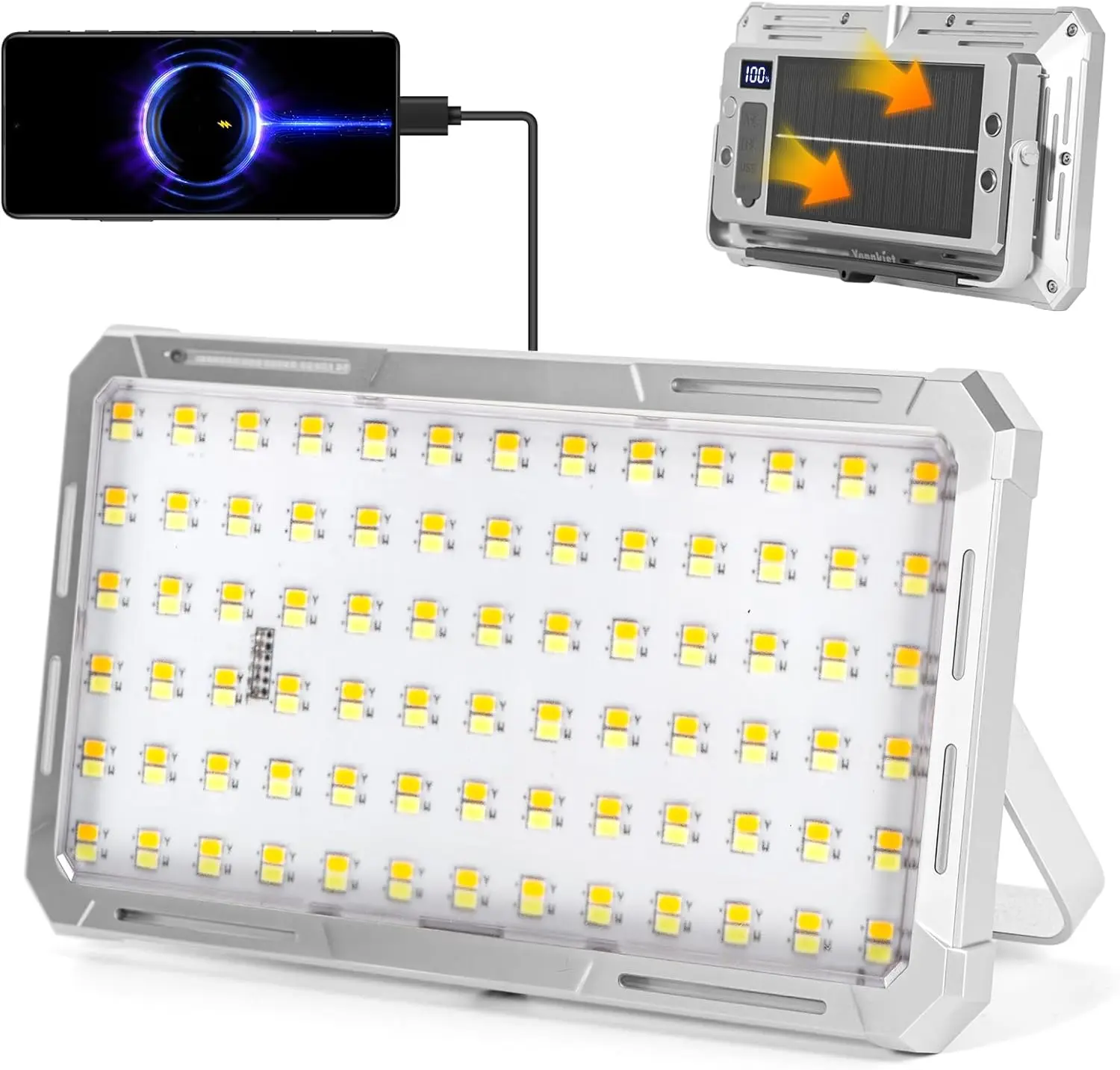
An ideal example of a successful combination of functions is a device like the Solar-Powered 178 LED Work Light with Magnetic Base, Power Bank, IP44 Waterproof. This gadget goes beyond the usual solar power bank, offering a comprehensive solution for camping, car repair, or home tasks.
Its main advantage is powerful illumination using 178 LEDs, providing bright and even light on the work surface. The magnetic base allows you to securely attach the light to any metal surface, freeing your hands. And the IP44 water resistance makes it resistant to splashes and humid environments. At the same time, it functions as a full-fledged power bank with a solar panel for charging mobile devices.
This approach demonstrates that modern devices can solve several tasks at once, saving space in your backpack and increasing the overall usefulness of the gadget. By choosing such a model, you get not only a backup power source but also a reliable light source, which is critically important in field conditions or emergency situations.
Hidden Pitfalls When Choosing: Common Mistakes
To avoid disappointment, it's worth knowing about common traps. The first is overestimating the capabilities of solar charging. Many expect the power bank to always be full thanks to the sun alone, but in practice, the main charging method often remains the mains adapter. The solar panel is more of a useful auxiliary tool for maintaining charge in extreme conditions.
Read real reviews, not just marketing descriptions.
The second mistake is ignoring real user reviews. It is in these that users often describe the actual performance of the solar panel in different weather, the real output capacity, and the durability of the case. Look for "solar power bank review" with an emphasis on long-term field use. The third problem is low-quality batteries. Cheap models may use cells that quickly lose capacity after a few charge cycles or are unsafe to use. Choosing trusted brands or models with detailed reviews will help avoid this.
Conclusion:
Choosing a high-quality power bank with a solar panel requires careful analysis of two key parameters: the power of the photocell and the battery capacity, which must be balanced. Equally important are additional features, the level of protection, and build quality. Multifunctional devices like a work light with a solar panel, power bank, and magnetic base offer an excellent balance of usefulness and practicality. The main thing is to form realistic expectations regarding the speed of solar charging and base your choice on detailed technical specifications and honest reviews from other users.