Modern people are surrounded by gadgets: smartphones, laptops, tablets, headphones, smartwatches, portable speakers. Each of them requires regular recharging, which often turns a desk or bedside table into a chaotic tangle of cables and power adapters. The solution to this problem is a universal charger for all devices simultaneously – a compact station capable of replacing a whole pile of separate adapters. This approach not only brings order but also enhances convenience and efficiency, especially during travel or when working away from home. However, to make a truly successful choice, it is important to understand the key characteristics and capabilities of such devices.

Choosing the ideal multi-charging device is a balance between power, number of ports, portability, and additional features. A wrong choice can lead to slow charging or the inability to connect the desired gadget. This article will be your guide to the world of universal power solutions. We will break down in detail which parameters to pay attention to so that a charger for all gadgets becomes a reliable assistant at home, in the office, and even in the field.
? Article Contents
Power and Total Output Power: The Main Selection Criterion
The first and most important thing is the power that the charger can deliver. It is measured in watts (W) and directly affects the charging speed and the list of devices that can be powered simultaneously. A lack of power is the most common mistake that renders a purchase useless.
For comfortable use, a modern multi-charger should have a total power output of 100W or higher. This will allow you to charge, for example, a laptop (which often needs 65-100W), a smartphone, and a tablet simultaneously. When choosing, focus on the sum of the power requirements of all your key gadgets you plan to connect together, and add a small margin.
In addition to total power, the power of each individual port is critically important, especially USB-C. For fast charging of laptops and powerful tablets, a USB-C port with Power Delivery (PD) support of 65W, 100W, or even more is necessary. Such ports are often marked separately.
How to calculate the required power:
Look at the original chargers of your devices. The power adapter usually indicates the voltage (V) and current (A). Multiply these values (e.g., 20V * 3.25A = 65W) to find the required power for each gadget. By summing the power of devices you plan to use simultaneously, you will get the minimum required power for the station.
Port Types and Quantity: Connection Versatility
The second key aspect is the arsenal of ports. A modern universal charger must support all types of connectors you have in your arsenal. The main focus today is on USB-C, but older standards should also be present.
The ideal set for most users includes:
- USB-C ports with PD: At least one, preferably two high-power ports (65W+). They are responsible for charging laptops, tablets, and flagship smartphones.
- USB-A (standard) ports: For charging older smartphones, headphones, speakers, e-cigarettes. It is desirable that they support fast charging technologies like Quick Charge.
- Standard 220V (AC) outlets: This makes the device truly universal. You can connect any mains-powered device: from a desk lamp or drone charger to a small refrigerator or projector.
The number of ports determines how many gadgets can be charged simultaneously without additional splitters. The optimal number is from 4 to 6 different ports. This will allow you to create a truly efficient charging station for home or office.
Battery and Autonomy: Freedom from the Outlet
Many modern multi-charging devices are equipped with a built-in battery. This transforms them from a simple outlet into a portable power station that can be taken on trips, outdoors, or used during a power outage. Battery capacity is measured in watt-hours (Wh) or milliamp-hours (mAh).
The higher the capacity, the more energy the device can store and the more full charge cycles it can provide for your smartphone or laptop. For example, a battery with a capacity of 12,000 mAh (at 3.7V this is approximately 44.4 Wh) can fully charge a smartphone with a 4000 mAh battery about 2-3 times. For serious autonomy, especially for powering a laptop, you should consider models with a capacity of 100 Wh or more.
It is also important to consider the ways to charge the station itself. The best models offer several options: from a 220V mains, from a car cigarette lighter (12V), and, which is particularly interesting, from solar panels. The latter option makes the device ideal for camping, hiking, and use in conditions where there is no access to electricity.
Additional Features and Safety
In addition to basic charging functions, a quality multi-charger should offer useful extras that enhance convenience and operational safety. These details often distinguish a good device from an excellent one.
Useful extras include:
- Built-in LED flashlight: An extremely useful function for travel, camping, or emergency situations. Often has several modes (constant light, strobe, SOS).
- Informational display: Shows the charge level of the station's own battery, input/output power, time until full charge. This gives full control over the process.
- Protection against overheating, overload, short circuit, and overvoltage: A set of protection systems is a mandatory requirement for any device working with electricity. It guarantees safety for both gadgets and the user.
Also, pay attention to the design and materials of the case. For portable use, compactness, lightness, and durability are important. The case should be made of high-quality plastic or metal, resistant to scratches and impacts.
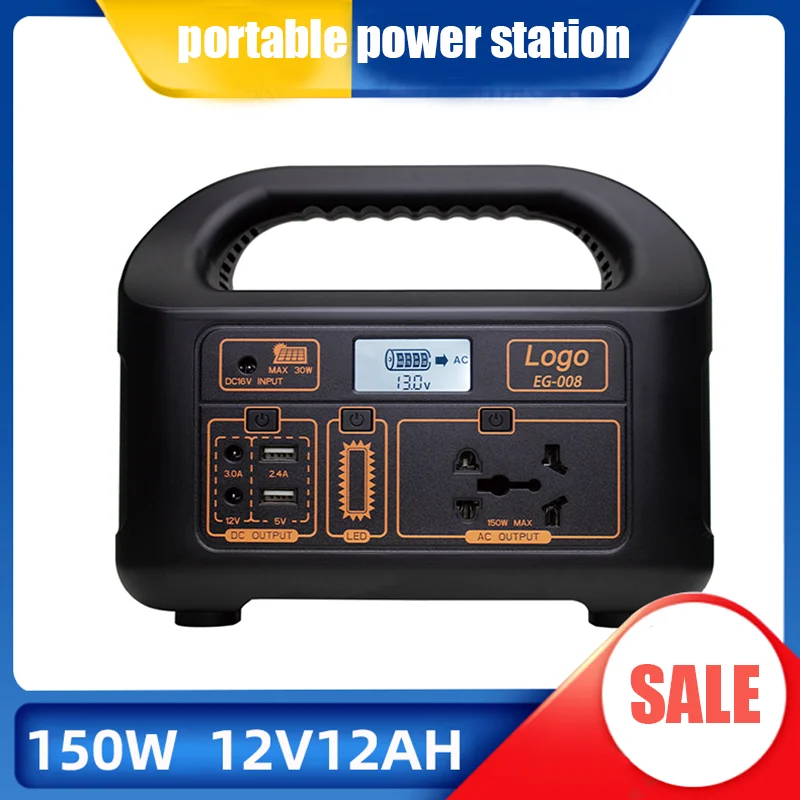
Portable Power Station DZ 150W Solar & AC220V/110V: A Universal Solution
As an example of a comprehensive approach to charging all gadgets simultaneously, consider the portable power station DZ 150W. This device integrates all the principles discussed above, offering a ready-made solution for various usage scenarios.
It is equipped with a powerful battery, a standard 220V outlet, USB-C and USB-A ports, allowing you to simultaneously power and charge virtually any household appliance and gadgets. A key advantage is the ability to charge the station itself not only from the mains but also from solar panels, making it indispensable for autonomous use in nature, during travel, or as a backup power source.
The presence of a built-in LED flashlight and an informational display adds to its practicality. Such a station is not just a charger for all gadgets, but a true mini-energy hub that provides complete independence