In the modern world, surrounded by a multitude of gadgets powered via USB, there is a need to know exactly what is happening with the power supply. An ordinary charger may not deliver the claimed power, a cable may have high resistance, and a new smartphone may not support fast charging from an old adapter. It is precisely to solve these problems that USB testers exist — compact devices that become indispensable assistants for tech enthusiasts, mobile repair technicians, and ordinary users who value control. They allow real-time monitoring of voltage, current, power, consumed capacity, and other key parameters of the charging or power supply process for any device via a USB port.
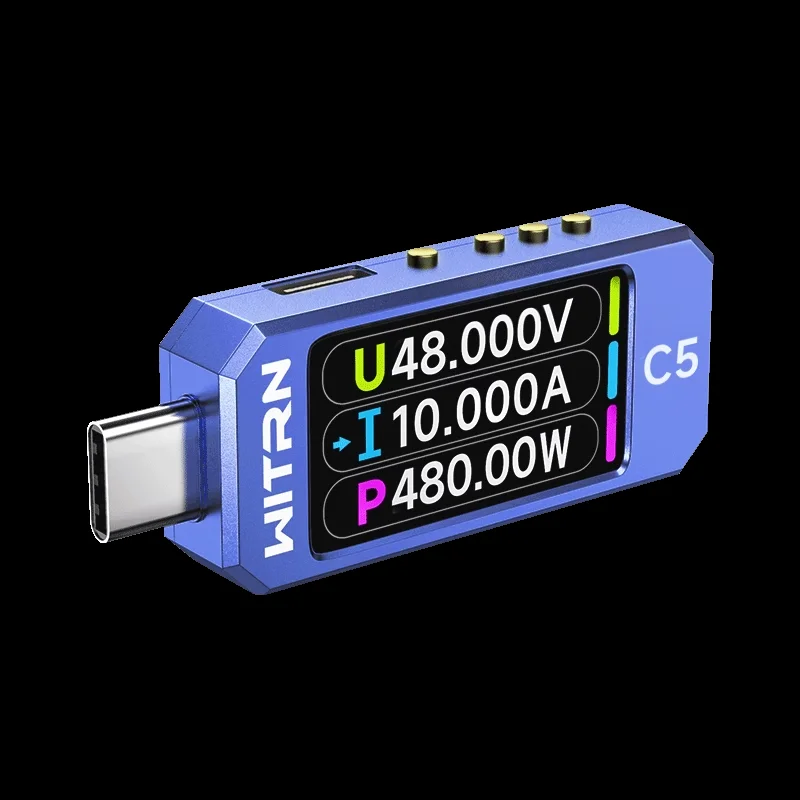
The choice on the market is huge: from simple indicators to feature-rich multimeters with support for the latest protocols. In this review, we will look at the key characteristics to pay attention to when choosing, and present one of the most powerful and functional devices in its class — the WITRN C5. This tester can not only display basic parameters but also analyze fast charging protocols, including PD 3.1, and perform professional diagnostics.
? Table of Contents
What is a USB tester and why is it needed
A USB tester is a compact electronic device that is inserted into the gap between the power source (charger, power bank, PC USB port) and the consumer (smartphone, tablet, other gadget). Its main task is to measure and display the electrical parameters passing through it. The simplest models have a small display showing voltage (V) and current (A), allowing for an approximate power calculation (P = V * A).
However, the scope of application is much broader than it seems. With a tester, you can accurately determine whether the charger meets the stated specifications. Have you ever encountered a situation where your phone "charges slowly" from a new adapter? The tester will instantly show the actual power reaching the device. It will also help identify a low-quality or damaged cable: if, when connecting a good charger, the voltage drops significantly under load and the current is limited, the problem is in the wire.
For those who work with power banks, the tester becomes an indispensable tool for checking the actual battery capacity (Ah/Wh counting function). It will accurately measure how much energy was actually delivered to the device, allowing you to weed out models with inflated marketing claims. Mobile repair technicians use testers to diagnose charging ports on smartphones and check the operation of power management controllers.
Key functions and selection parameters
Before buying a USB tester, it is important to understand which functions will be useful to you. The basic parameter is the voltage and current measurement range. Cheap models are often limited to 5V/3A, which is no longer sufficient for modern devices with powerful charging. It is better to choose devices with a margin, for example, up to 30V and 5A or more.
Display and measurement accuracy.
The quality of the display directly affects the ease of use. A large, high-contrast screen with good resolution allows you to see the numbers clearly. Measurement accuracy is usually indicated as a percentage (e.g., ±0.5% for voltage) — the lower this value, the more reliable the data you receive. The data refresh rate on the screen is also important, especially when observing dynamic processes.
Advanced functions include: measuring consumed capacity (mAh) and energy (Wh), ideal for testing power banks; automatic shutdown; recording maximum values; analyzing fast charging protocols (Quick Charge, Power Delivery, etc.). The latter function is one of the most important for modern users, as it allows you to accurately understand which protocol is activated and with what parameters.
Review of the powerful WITRN C5 tester
The WITRN C5 model is a representative of a new generation of USB testers that combines the functions of a voltmeter-ammeter, protocol analyzer, and diagnostic device. It supports operation with voltages up to 28V and currents up to 5A, covering all modern standards, including powerful laptops charging via USB-C. Its main advantage is full support for analyzing Power Delivery (PD) protocol version 3.1 with Extended Power Range (EPR), allowing it to work with power up to 140W.
Professional diagnostics and user-friendly interface.
The WITRN C5 is equipped with a color TFT display with an intuitive menu. In addition to standard V, A, W, PPS measurements, it can display a charging curve, record maximum/minimum values, and maintain a capacity counter. Particularly interesting is the "aging detection" function — detecting cable aging. The device evaluates the cable's resistance and its ability to transmit current, helping to determine whether the wire has lost its characteristics over time.
The tester also has built-in support for UFS (Ultra Fast Charging) protocols and the ability to automatically recognize and activate fast charging protocols from various manufacturers (Huawei SCP, Samsung AFC, Qualcomm QC, etc.). This makes it a universal tool for testing any charger or gadget on the market. Connection is made via a USB-C port, which aligns with modern trends.
Comparison with other types of testers
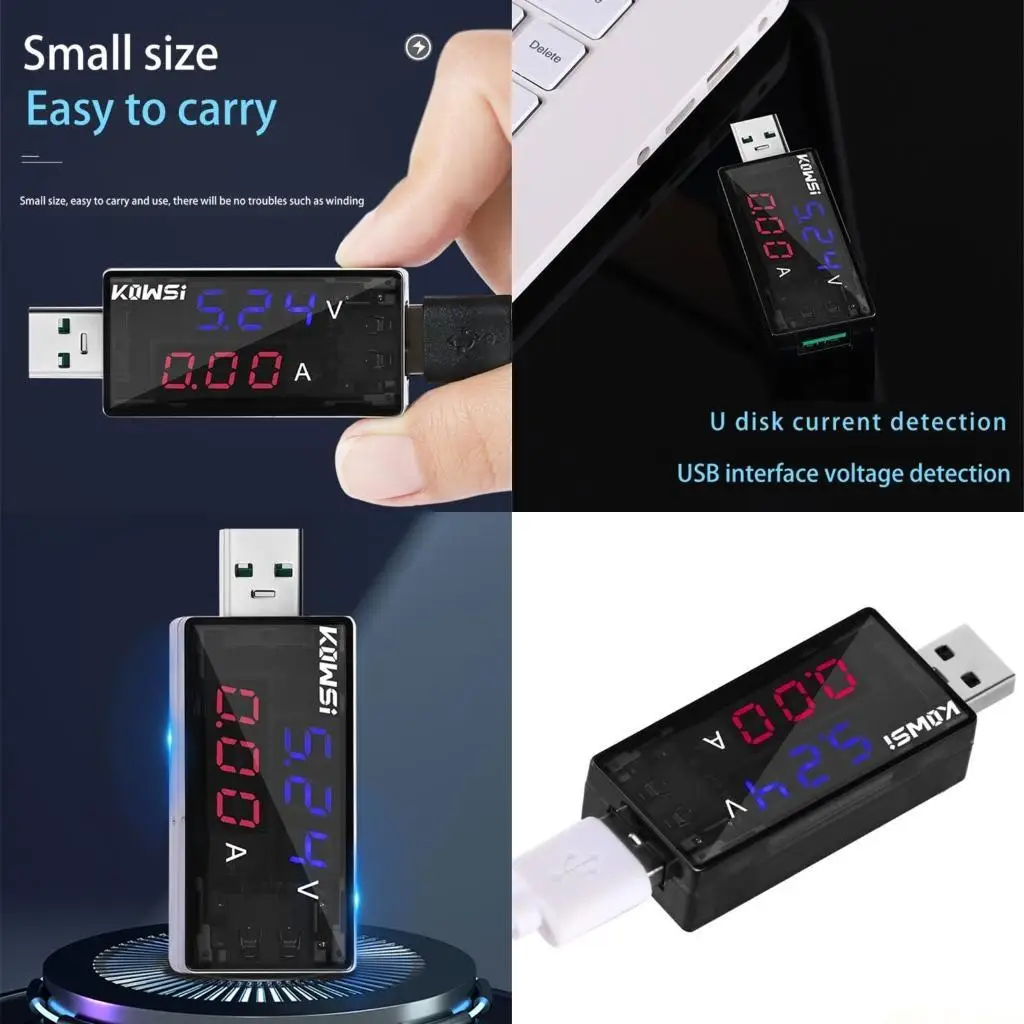
There are different categories of USB testers on the market. The simplest models with a monochrome display, such as the popular UM24C, offer a good price-to-quality ratio for basic measurements. They are perfect for household use: checking chargers, testing power banks. However, their functionality is limited, and protocol support is often absent or basic.
More advanced analyzers, like the FNB58 or Fnirsi FNC88, are focused on detailed analysis of communication protocols between devices. They can decode PD messages, which is useful for developers and in-depth diagnostics. The WITRN C5 occupies an intermediate but very powerful niche: it combines a user-friendly interface, high measurement accuracy, full support for modern charging protocols, and unique diagnostic functions, such as cable testing.
Thus, the choice depends on your needs. For development, a protocol analyzer is needed. For daily checks, a simple tester is sufficient. But if you need one universal device for comprehensive testing of your entire ecosystem of USB devices, from old chargers to new laptops with PD 3.1, then models like the WITRN C5 are the optimal choice.
Practical application: usage scenarios
To better understand the benefits of a USB tester, let's consider a few real-world scenarios. Imagine you bought a new 20000 mAh power bank. By connecting a discharged smartphone to it via the tester, you can accurately measure how much energy it will actually deliver. Often, the actual capacity turns out to be 20-30% lower than stated, which helps avoid disappointment.
Another common situation is charging a laptop via USB-C. Are all cables equally good? By connecting the WITRN C5, you will immediately see whether the PD protocol has been activated, at what voltage and current the charging is happening, and whether the cable is overheating. This is safe and informative. The tester is also indispensable for choosing the optimal charger at home or in the office when you need to distribute a limited number of outlets among powerful devices.
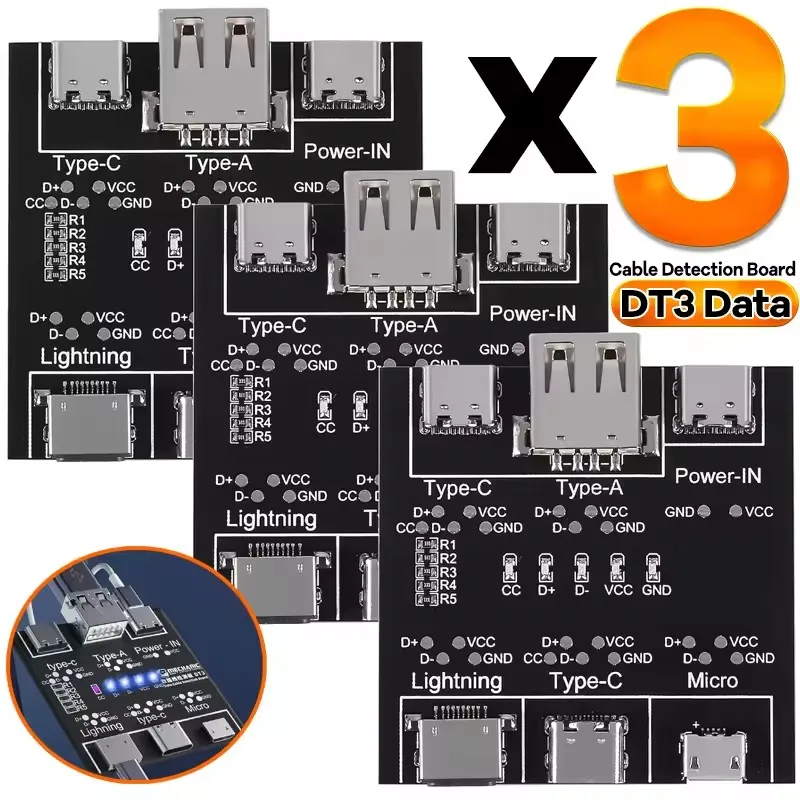
For mobile repair technicians, this is a standard tool. Diagnosing a "won't charge" fault starts precisely with checking whether power is reaching the board, what its parameters are, and whether the handshake protocol is passing. The WITRN C5, with its cable aging detection function, allows you to quickly rule out this common cause.
Conclusion:
The USB tester has evolved from a simple measuring device into a complex diagnostic tool necessary for anyone dealing with various electronics. It provides transparency, safety, and control over the power supply process of your gadgets. Among the entire variety of models, you should choose a device that meets your current and future needs, taking into account support for new charging protocols.
The WITRN C5 model, with its support for PD 3.1 EPR, cable condition checking function, and wide measurement range, is one of the best choices for those seeking a universal, accurate, and future-oriented solution. It is an investment in long-term operation and understanding of the operation of your entire digital power infrastructure.