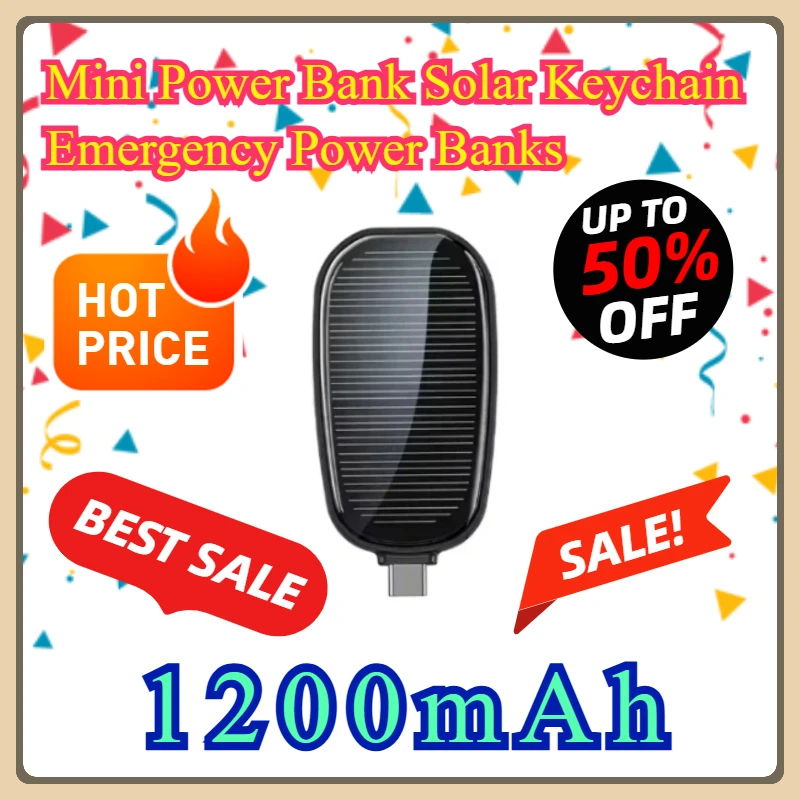
In the world of mobile devices, new charging solutions are constantly emerging that promise to make our lives easier. One such trend is power banks with built-in cables, which eliminate the need to carry separate wires. But are they truly the ideal choice, or do they have significant drawbacks? In this review, we will take a detailed look at the concept, advantages, and potential problems of such devices, as well as analyze a specific model — the compact For Phone 1200mAh power bank with a solar panel. This will help you understand who this gadget is suitable for and what to pay attention to before purchasing.
? Table of Contents
What is a Power Bank with a Built-in Cable?
A power bank with a built-in cable is a portable battery with one or more charging cords integrated into its body. Most often, these are cables with Micro-USB, USB-C, or Lightning connectors that pull out from a special compartment or wrap around the body. The main idea is maximum mobility and minimalism: you don't need to remember a separate wire; it's always with you.
This approach is especially relevant for compact models designed for emergencies or short trips. For example, the For Phone 1200mAh model is positioned as a "pocket" or "keychain" power bank. Its capacity is enough to charge a modern smartphone by 10-30%, which saves the day when the battery is about to die and a power outlet is still far away. The built-in cable here becomes a key element of convenience, making the device ready for instant use.
Unquestionable Advantages: Convenience and Mobility
The main advantage of such power banks is obvious — incredible convenience. You no longer have to rummage through your bag looking for the right cable or worry about forgetting it at home. Everything you need is already in one device. This is ideal for an active lifestyle, short city trips, outdoor recreation, or situations where you need to minimize what's in your pocket.
Compactness as the main trump card.
Models like the For Phone 1200mAh are often very small and lightweight, allowing you to carry them on your keys or in a small pocket. The solar panel, which this model is equipped with, adds autonomy: under ideal conditions, it allows you to slightly charge the power bank's battery from the sun. This can be useful on hiking trips or in emergency situations. Thus, the main use case is not a full charge, but a quick "rescue" top-up for your gadget.
Disadvantages and Reliability Concerns
However, convenience comes at a price, and the main issue concerns reliability. The built-in cable is another mechanical element that is subject to physical stress. Constant pulling and winding can lead to wire fraying, loosening of contacts, or breakage of the locking mechanism. Unlike a separate cable, which can be easily replaced, a broken built-in cable often renders the entire power bank unusable.
Another significant drawback is versatility. If your power bank has only one built-in cable (e.g., Micro-USB), you won't be able to charge a device with USB-C without an adapter. This limits its use. Furthermore, compactness is usually achieved at the expense of capacity. 1200mAh is a very small amount of energy for modern smartphones with batteries of 3000mAh or more. Such a power bank is exclusively an emergency solution.
Review of the For Phone 1200mAh Solar Power Bank Model
Let's look at a specific example — the compact For Phone power bank with a solar panel. Its main features: very small size, weight around 50-70 grams, battery capacity of 1200mAh, and a built-in cable (usually Micro-USB). The solar panel on the body allows for slow charging of the internal battery from sunlight.
Who is this model for?
This power bank is ideal as a secondary, emergency device. You can hang it on your backpack or keys and forget about it until a critical moment. It can provide one short charging cycle, for example, allowing you to make an important call or use maps. The solar panel is more of a symbolic bonus, as its efficiency is low, and a full charge from the sun would take several days. You shouldn't rely on it as a primary power source.
As for quality, in such budget compact models, everything depends on the specific manufacturer. The built-in cable mechanism may not be very durable, so you should handle it carefully, avoid sudden movements, and not pull the wire at an angle. The 1200mAh capacity might actually provide around 700-800mAh of usable capacity, which is only enough for a small top-up.
Criteria for Choosing a Power Bank with a Cable
If you decide to buy a power bank with a built-in cable, pay attention to a few key parameters. First, the type of built-in connectors. Ideally, it's a universal model with two cables (e.g., USB-C and Lightning) or at least with the most common one for your devices. Second, the actual capacity. The stated capacity (1200, 5000, 10000mAh) is the capacity of the internal cells. The usable capacity that goes into charging your phone is always lower due to losses.
Third, the build quality of the body and the cable mechanism. Prefer models made of durable plastic with clear cable holders. If the cable is stored in a special groove, check how easily it pulls out and how securely it "clicks" back in. Additional features, like a solar panel or a built-in flashlight (which is often found in such models), can be useful but should not be the main selection criteria.

Conclusion:
Power banks with built-in cables, such as the For Phone 1200mAh Solar, are an excellent solution for emergencies and maximum mobility when convenience is the priority, rather than a full, multi-time charge. They save the day when your phone dies at the most inopportune moment. However, it's worth being aware of their limitations: low capacity, potential risks regarding the durability of the cable mechanism, and lack of versatility. Such a gadget is ideal as a secondary, emergency power bank for your keys or backpack, but it is unlikely to replace a powerful main station for long trips.