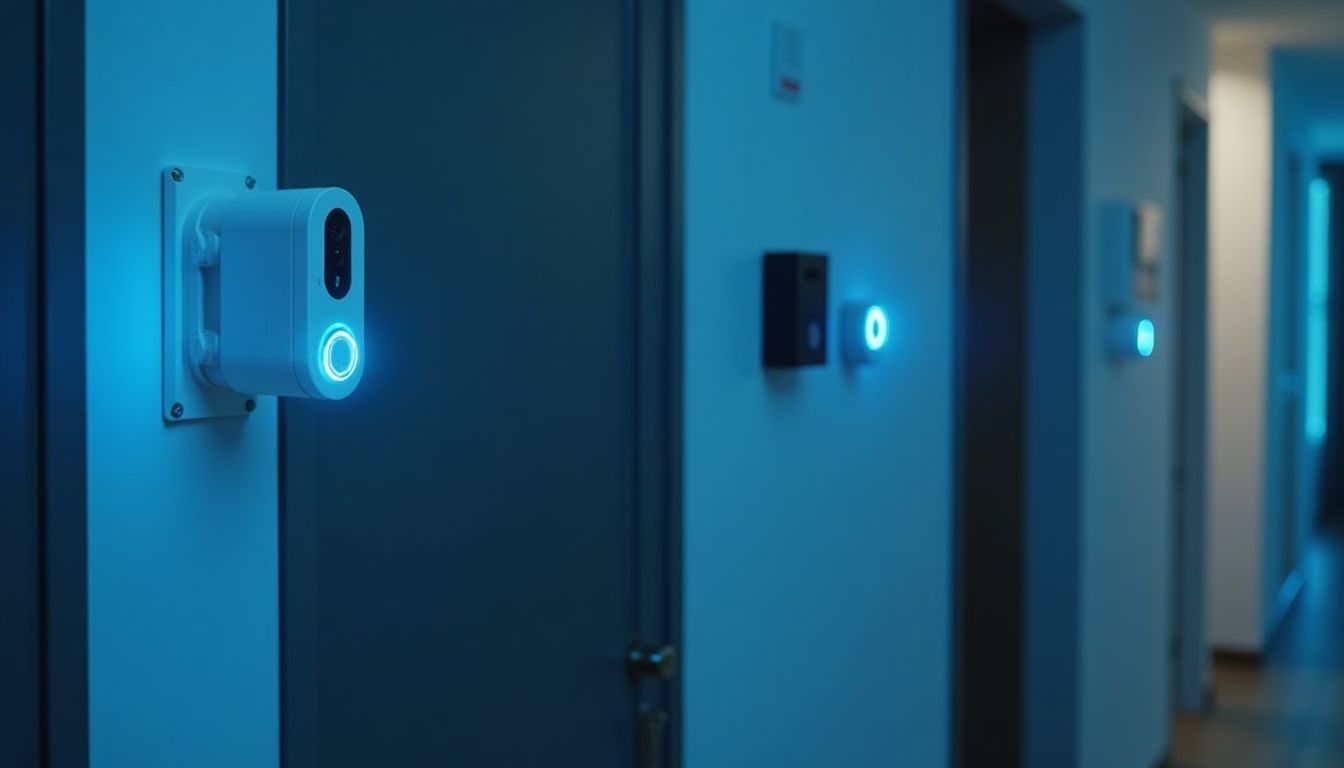
Solar-powered surveillance cameras are a solution that promises full autonomy and no hassle with running wires. But is everything so clear-cut in practice? The ComfortShop editorial team analyzed open sources and the specifications of popular models to figure out where such technology works well and where its capabilities are exaggerated. In this article, we will examine the key features, limitations, and use cases of a wireless solar-powered camera.
Article Contents
How a solar surveillance camera works

The operating principle is simple: a photovoltaic module converts sunlight into electricity, which is stored in a built-in battery. This battery powers the camera itself, the motion sensors, and the wireless communication module. Thanks to this, a solar surveillance camera can operate where there is no access to a power outlet.
It is important to understand that the solar panel in such kits is not the primary power source but a charging device. The main energy storage remains the lithium-ion or lithium iron phosphate battery. Its capacity determines how many days the camera will operate without sunlight. In most models, this reserve ranges from 3 to 7 days in standby mode.
The panel's performance directly depends on its area and tilt angle. Small built-in panels on the camera body are often unable to fully compensate for power consumption during active recording. Therefore, manufacturers recommend installing a home solar-powered camera so that the panel receives direct sunlight for at least 4–6 hours a day.
Key advantages of wireless solutions
The main advantage is obvious — no power or video signal cables. This simplifies installation and allows the camera to be placed in locations where running wires is impractical or impossible: fences, gates, garden plots, construction sites. A wireless video recorder with a solar panel can be moved from place to place without hiring specialists.

The second advantage is environmental friendliness and savings on electricity. Although the savings from a single camera are small, for systems with multiple surveillance points they become noticeable. Moreover, such cameras often have weather protection rated IP65 or IP66, allowing them to operate outdoors year-round.
The third plus is integration with smart home systems. Most modern models support Wi-Fi, two-way audio, and smartphone notifications. This turns a simple solar camera into a full-fledged element of a security system controlled from an app.
When the solar panel is not enough: real limitations
Based on the analysis of specifications, ComfortShop recommends paying attention to the climatic conditions of the region. During cloudy autumn-winter periods, energy generation can drop by 70–90%. If the camera is installed in the shade or on the north side of a building, the battery will discharge faster than it charges.


Another limitation is power consumption during frequent motion sensor triggers. If the camera is aimed at a busy street or a place where tree branches constantly move, it will record dozens of events per day. This quickly drains the battery, and the solar panel may not keep up with recharging it.
Temperature limitations should also be considered. Lithium-ion batteries lose capacity in frosts below -10 °C, and at -20 °C they may temporarily shut down. For year-round use in cold regions, it is worth choosing models with lithium iron phosphate batteries or providing the option of periodic manual charging.
What to look for when choosing
First of all — battery capacity and solar panel power. A battery of at least 5000 mAh and a panel of at least 5 W is considered optimal for year-round operation. If the panel is smaller, it will rather maintain the charge during the warm season but will not save the day in winter.
Second — resolution and field of view. For recognizing faces or license plates, a resolution of at least 2K (2560×1440) is required. A wide-angle lens from 120° will allow one camera to cover a larger area. Check the price on the seller's website, as the cost of models with similar specifications can vary significantly.
Third — connection type. Wi-Fi cameras are easier to set up but depend on network stability. For remote areas without internet, models with 4G SIM card support are suitable. Also, pay attention to the availability of local storage — a microSD slot or support for network video recorders.
Popular use cases
Most often, a home solar-powered camera is installed at entrance gates, wickets, fences, and in the garden. Here it performs the function of primary surveillance: it detects a person approaching, sends notifications, and records the event. Such cameras are less suitable for continuous 24/7 recording due to limited battery capacity.
The second scenario is temporary surveillance of construction sites, country properties, or warehouse areas. Here, mobility and quick installation are valued. A wireless video recorder with a solar panel can be deployed in minutes and moved as needed.
The third scenario is monitoring animals or remote monitoring of distant objects. In such cases, solar-powered cameras are often the only practical solution, since running cable over long distances costs more than the equipment itself.
Installation and maintenance: what you need to know
Proper installation is half the battle. The panel should be oriented south (in the northern hemisphere) at an angle of 30–45 degrees. Avoid places where shadows from trees, buildings, or fences will fall on the panel during daylight hours. Even partial shading can reduce generation by 50% or more.
Maintenance comes down to periodically cleaning the panel surface from dust, leaves, and snow. A dirty photovoltaic cell loses up to 30% of its efficiency. It is also worth checking the battery status in the app: if the charge level systematically drops below 20%, the panel may need reorientation or replacement with a more powerful one.
Having analyzed open sources, the ComfortShop editorial team notes that most problems with solar cameras are related precisely to incorrect installation, not equipment defects. Before purchasing, it is worth checking the price on the seller's website and reviewing the warranty terms of the specific manufacturer.
Conclusion:
A wireless solar-powered camera is a working solution for autonomous video surveillance if you correctly assess the operating conditions. It is well suited for places without access to the power grid, for temporary installation, and as an additional element of a security system. According to the ComfortShop editorial team's recommendation, choose models with a battery of at least 5000 mAh and a panel of at least 5 W, and also consider the number of sunny days in your region.
Frequently asked questions
How long does a wireless solar-powered camera operate in cloudy weather?
Depending on the model and battery capacity, most solar cameras can operate for 3 to 7 days without direct sunlight before fully discharging.
Can a home solar-powered camera be used in winter or at sub-zero temperatures?
Yes, most models are designed to operate at temperatures down to -20°C, but in winter the efficiency of solar charging drops significantly, so it is worth choosing models with a large battery or the ability to additionally charge via USB.
Is internet required for a wireless video recorder with a solar panel to work?
Wi-Fi is needed for viewing video in real time and receiving push notifications, but most cameras can record video to an SD card even without a network connection.
How can a solar surveillance camera be protected from theft?
Choose models with an anti-tamper alarm function and mounting that requires special tools for removal, and also install the camera in a hard-to-reach location.