Stargazing is not just a fascinating hobby, but a true journey into the world of science that expands the boundaries of a child's imagination. Parents who want to give their child this boundless cosmos often face a logical question: at what age should you buy a telescope for a child, so that the instrument does not turn into a complicated toy, but becomes a gateway to knowledge. Too early an introduction can discourage interest due to the complexity of setup, while the right moment can ignite the spark of a researcher for life. According to the recommendation of the ComfortShop editorial team, the key to success is a balance between the optical power of the device and the psychological readiness of the young astronomer, so today we will take a detailed look at the age-specific features of choosing one.
Article Contents
The optimal age for a first telescope: expert opinion
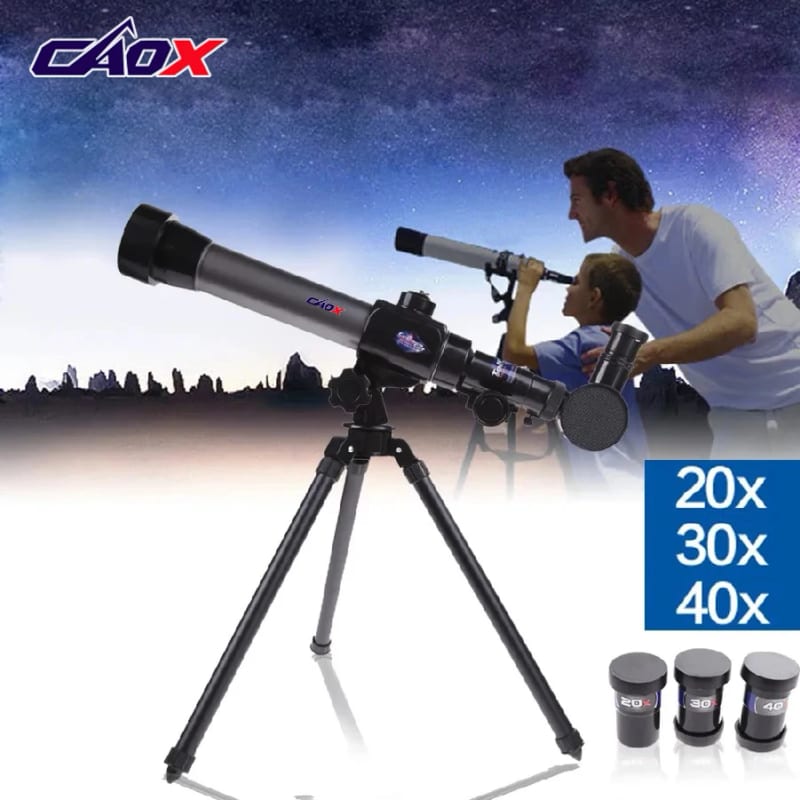
Most manufacturers of optical equipment and child psychologists agree that a conscious interest in astronomy awakens no earlier than 5–6 years of age. At this age, a child is already able to understand basic instructions, look into the eyepiece with one eye, and focus their gaze on distant objects. However, a telescope for children from 6 years old is always a compromise between functionality and simplicity, because a complex equatorial mount or overly sensitive focusing will only frustrate a young child.
When it comes to numbers, the age range can be roughly divided into three categories. For the youngest (up to 5 years old), it is better to stick with quality binoculars or toy models without complex mechanics. Between the ages of 6–10, the golden time arrives for a children's telescope for beginners — a refractor with an alt-azimuth mount that is intuitively easy to operate. And a telescope for a schoolchild review should be considered from 10–12 years old, when the child is ready to study the structure of the Solar System using star charts and can independently point the instrument at deep-sky objects.
Child's readiness: what to pay attention to before buying.
Before deciding at what age to buy a telescope for a child, it is worth assessing their patience and level of interest. If the child spends hours looking at pictures of planets in books, asks questions about black holes, and watches science cartoons with delight, then the moment has most likely arrived. Technically, it is important to understand: up to 7–8 years old, it is still difficult for a child to coordinate movements for precise pointing at a star, so parents will have to take an active part in observations, which, on the other hand, will become a wonderful family ritual.
Types of designs: what to choose for a beginner
The assortment in modern stores is impressive, but for a child it is fundamentally important not to get confused by terms like "aperture" or "focal length." ComfortShop experts advise starting with the two most common types: lens refractors and mirror reflectors, each of which has its own advantages for young users.
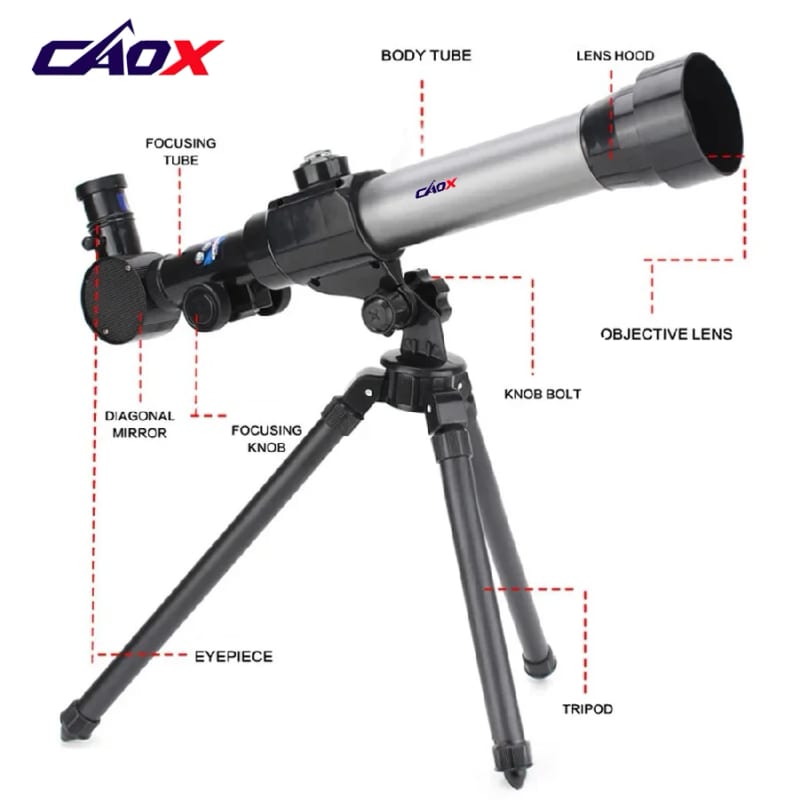
The classic refractor is the ideal children's telescope for astronomy at the entry level. It is low-maintenance, does not require collimation (mirror alignment), and provides a clear, contrasty image of the Moon and planets. The closed tube protects the optics from dust, which is critical when the device is used by a restless child. The reflector, in turn, offers a larger aperture for the same money, allowing you to see faint nebulae, but it requires more careful handling and periodic adjustment, making it more suitable for teenagers.
Alt-azimuth or equatorial: mounting for a child.
For a first introduction, you should definitely choose an alt-azimuth mount (movement up-down, left-right); it is intuitively understandable even for a first-grader. An equatorial mount with counterweights and polar axis alignment is a task for a high school student seriously interested in astrophotography. ComfortShop reviewers have repeatedly emphasized: the best telescope for a beginner is the one you want to use often, not the one that gathers dust due to the complexity of assembly.
Key characteristics: what not to skimp on
When the task arises of how to choose a telescope for a child, many parents mistakenly chase the maximum magnification indicated on the box. In reality, large magnifications (400x, 600x) on cheap models are a marketing gimmick, since physically the quality of the image is limited by the diameter of the objective lens.
The main parameter is aperture (the diameter of the primary mirror or lens). For a children's telescope for beginners, 60–70 mm in a refractor or 76–90 mm in a reflector is sufficient. This is enough to see Saturn's rings, Jupiter's moons, and the phases of Venus. Also, pay attention to the quality of the eyepieces — the kit should include at least two interchangeable ones for different magnifications, and the focuser barrel should preferably be standard (1.25 inches) so that accessories can be purchased later.
Equally important is the stability of the tripod. A wobbly design will negate any attempts at focusing, as the image will shake at the slightest touch. Metal or sturdy aluminum legs with locks are a mandatory condition if you really want to enjoy observations rather than fight vibrations.
Additional accessories and observation safety
When buying a children's telescope for astronomy, you should immediately take care of safety, since a child's first desire is to look at the bright daytime Sun. Doing this without a special aperture solar filter is strictly forbidden — it leads to immediate and irreversible damage to the retina. Be sure to give instructions and store the solar filter in an inaccessible place, taking it out only under adult supervision.
Among the useful additions that will increase comfort, we can highlight:
- Barlow lens — doubles or triples the magnification without changing the eyepiece.
- Moon filter — reduces the brightness of the full Moon, making observations comfortable.
- Red dot finder — significantly simplifies pointing at an object for a child.
- Smartphone adapter — allows you to take your first astrophotographs and share impressions with friends.
These little things turn an ordinary observation into a full-fledged exploration, supporting a schoolchild's motivation to study astronomy.
Conclusion:
Choosing a first telescope is an investment in a child's intellectual development, so there is no need to rush into a purchase before 5–6 years of age, but you also shouldn't postpone it if you see genuine interest. The optimal solution would be a telescope for children from 6 years old of the refractor type on a sturdy tripod with an alt-azimuth mount, which will not disappoint with its complexity and will show the beauty of the Moon and planets. Remember that even the best children's telescope for beginners requires adult participation at the start, but it is these shared evenings under the starry sky that remain in memory forever, opening up the boundless Universe before the young explorer.
Frequently Asked Questions
At what age can you buy a children's telescope for astronomy?
The optimal age for a first introduction to a telescope is 6-7 years old, when the child already understands the rules of careful handling of optics. For children from 6 years old, it is better to choose simple models with a sturdy tripod and intuitive pointing.
Which telescope should a beginner schoolchild choose?
For a beginner schoolchild, a refractor with an aperture of 70-80 mm on an alt-azimuth tripod is best — it does not require complex setup and immediately shows the Moon and planets. Avoid cheap models with plastic optics that quickly disappoint a child.
Is it worth buying an expensive telescope for a child if they might lose interest?
You should not immediately buy an expensive device — for a first experience, a budget model is sufficient, but with glass optics and reliable mounting. If the interest in astronomy persists for a year, then you can consider a more serious model.
How to choose a telescope for a child so that it is easy to use?
The main thing is that the child can independently point the telescope at an object without adult help, so choose models with simple manual control and a lightweight tripod. The tripod height should match the child's height, and the eyepiece should be at a comfortable level so they don't have to stretch or squat.