Why a child needs a protective helmet

Children's activity is constant movement, exploring the world and, unfortunately, inevitable falls. Bicycle, scooter, roller skates or skateboard — each of these modes of transport requires a responsible approach to safety. That is why a children's protective helmet is not just an accessory, but a basic element of equipment that can save a child from serious head injuries.
According to the recommendation of the ComfortShop editorial team, protection should be chosen before the child first gets on a bicycle or scooter. The habit of wearing a helmet from an early age forms the right safety culture for life. A child who is used to a helmet from the age of three perceives it as a natural part of a walk, not as a parent's whim.
In addition to the psychological aspect, it is important to understand the physical one: a child's skull is still in the formation stage, so even a minor impact can have long-term consequences. Therefore, the question of "buying a children's helmet" is not about choice, but about a mandatory step of responsible parenting.
Key selection criteria: weight, ventilation, fit
Before moving on to specific models, it is worth defining the main parameters that affect comfort and safety. A children's bicycle helmet should be lightweight — the optimal weight is 200–350 grams. A heavier product puts additional strain on the cervical spine, which is especially critical for toddlers from 3 years old.

Ventilation is the second most important criterion. Active riding in summer without a sufficient number of ventilation openings leads to overheating, discomfort and the child's desire to take off the helmet. Quality models have from 8 to 15 openings that ensure a constant flow of air.
Fit is the third pillar of the right choice. The helmet should not press, slide down over the eyes or wobble. The adjustment system should allow precise fitting to the head circumference. Having analyzed open sources, the ComfortShop editorial team notes: the most convenient for children are models with a rear adjustment wheel that can be turned even with one hand.
Scooter helmet: features and differences
A children's scooter helmet has its own specifics. Unlike a bicycle helmet, where falls over the handlebars forward prevail, on a scooter a child more often falls sideways or backward. This means that the protection of the occipital part should be reinforced, and the shape should be deeper.

Modern scooter models often have integrated protection for the temple areas and an extended occipital zone. It is also worth paying attention to the presence of soft inserts inside that absorb impact and increase comfort. For children who alternate between a scooter and a bicycle, a model with CPSC or EN 1078 certification, which covers both types of activity, would be a universal solution.

Separately, mention should be made of a helmet for a child from 3 years old — at this age, the head size is usually 48–52 cm, which corresponds to size XS/S in most manufacturers. It is important not to buy a helmet "to grow into": it should sit snugly, but without pressure, and the gap between the eyebrows and the front edge should not exceed two fingers.
Children's helmet for roller skates and skateboarding: what to look for
A children's roller skate helmet differs from a bicycle helmet primarily in shape. For roller skates and skateboarding, falls backward are typical, so such helmets have a deeper fit that covers the back of the head and the base of the skull. They are often made in a "bowl" shape without pronounced aerodynamic protrusions.
The material of the outer shell also matters. For roller skates and skateboarding, it is better to choose models made of ABS plastic or polycarbonate — they withstand repeated impacts without losing their protective properties. The inner layer of EPS foam absorbs impact energy by deforming upon strong collision.
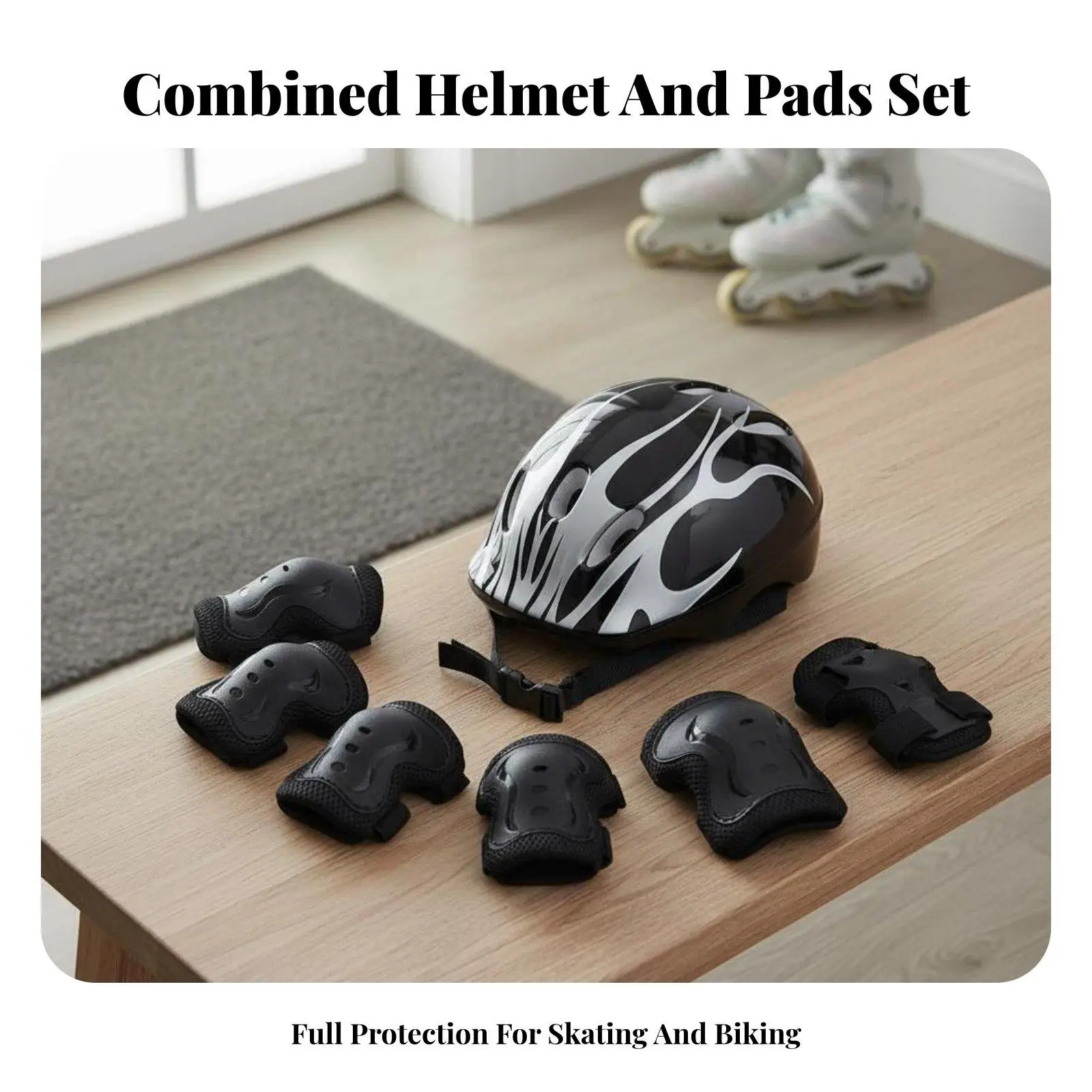
If a child is involved in several types of activity, it is worth considering multi-sport models. They are certified for bicycles, scooters, roller skates and skateboards at the same time, which eliminates the need to buy a separate helmet for each type of transport.
Protective materials and technologies
The modern market offers two main types of construction: in-mold and hardshell. The in-mold technology involves fusing the outer shell with the inner polystyrene foam layer, which provides light weight and excellent ventilation. Hardshell is a separate outer shell glued to the foam layer; such models are heavier but cheaper to produce.
For the youngest riders, manufacturers add to the construction a protective helmet with extended coverage of the temples and forehead. This is especially relevant for children aged 3–5, whose motor coordination is not yet sufficiently developed. Soft pads on the straps prevent chafing of the chin, and the magnetic buckle allows the child to independently remove the helmet without the risk of pinching the skin.
Based on the analysis of characteristics, ComfortShop recommends paying attention to the presence of reflective elements. At dusk, they make the child visible to drivers, which significantly reduces the risk of road accidents involving a young cyclist or scooter rider.
How to properly measure the head and choose the size
Accurate measurement of the head circumference is the key to the right choice. Take a measuring tape, wrap it around the child's head 2 cm above the eyebrows and over the ears. The resulting value in centimeters will be the guideline for selecting the size.
Most manufacturers use the following gradation: XS (46–51 cm) for children 3–5 years old, S (51–55 cm) for 5–8 years old, M (55–58 cm) for 8–12 years old. However, these boundaries are conditional, so you should always focus on the actual head circumference of the specific child.
After putting it on, the helmet should sit level, without sliding onto the back of the head or forehead. The straps form a "V" shape under the ears, and the buckle does not press on the chin. If more than two fingers fit between the strap and the chin, the helmet is not tightened enough.
Висновок:
Buying a children's helmet means making an investment in the health and safety of the child. Regardless of whether it is a bicycle, scooter, roller skates or skateboard, properly selected protection reduces the risk of serious head injuries by 85%. When choosing a model, consider weight, ventilation, type of construction and size compliance. The ComfortShop editorial team advises not to skimp on safety and to choose certified helmets from trusted manufacturers that guarantee real protection, not just its imitation.
Frequently Asked Questions
How to choose the size of a children's protective helmet?
Measure the child's head circumference with a measuring tape above the eyebrows and choose a model that sits snugly but does not press on the head. The helmet should not shift forward or backward, and the gap between the eyebrow and the edge of the helmet should be no more than two fingers.
How is a bicycle helmet different from a scooter or roller skate helmet?
Modern universal models are suitable for all these activities, but for a trick scooter or roller skates, it is better to choose reinforced helmets with a stronger outer shell and occipital protection. For regular bicycle riding, a classic lightweight bike helmet with good ventilation is sufficient.
From what age does a child need a protective helmet?
A helmet for a child from 3 years old is needed immediately as soon as they start riding any transport — from a balance bike to a tricycle. Even for the youngest, there are special lightweight models that protect the head during the first falls.
Where to buy a children's helmet and how to check its quality?
You can buy a children's helmet in sports stores or trusted online stores, paying attention to the presence of CE or EN 1078 safety certificates. Before purchasing, make sure the helmet has a size adjuster, a soft inner layer and no sharp edges or foreign odor.